


What to See in Tbilisi: The Highlights in 1, 2 and 3 Days
Tbilisi is a city where in a single evening you can climb a fortress, go down into sulfur baths and finish with dinner overlooking the illuminated Bridge of Peace. The center is compact, most of Tbilisi’s sights can be covered on foot, and where the climb is steep, cable cars and a funicular come to the rescue. I have walked these streets many times myself, so below you won’t find a “top 24 from the internet” list, but routes that actually work, with my own tips.
In brief: what to see in Tbilisi
- In 1 day: Bridge of Peace and Rike Park → Queen Darejan’s Palace and Metekhi → sulfur baths and the canyon with the waterfall → Narikala and Kartlis Deda → Betlemi (Ateshga, Upper Betlemi, Frida) → Sololaki (Gudiashvili Square, the school, the Writers’ House) → Freedom Square → Shavteli and the Gabriadze Tower at 7 p.m. → dinner on Shardeni.
- In 2 days: Agmashenebeli Avenue and Fabrika, the Dry Bridge and the House of Justice, Rustaveli Avenue and an evening on Mtatsminda (plus Avlabar with “Mimino” and Sameba, if you like).
- In 3 days: your choice: Turtle Lake and the Tbilisi Sea; the Botanical Garden and Tabori; non-touristy Tbilisi with markets and shopping malls.
- How many days to spend in Tbilisi: 2–3 days is enough to see the main sights; 4–5 if you also want day trips to Mtskheta, Kakheti or Kazbegi.
- Best time for walking: morning and evening; in summer it is hot at midday, and the climbs are steep.
- Getting around: on foot + metro + cable cars; it is most convenient to pay for the metro and buses with a Metromoney card.
If you want to see everything on a map right away, it is in the section “Tbilisi Sights on the Map” below.

What to See in Tbilisi in 1 Day: The Old Town Loop
One day means the old town and both banks of the Kura. The route is built so that you reach Darejan’s Palace in the morning (it receives visitors only until 2 p.m.), find yourself on Narikala at sunset and spend the evening in the cozy cafés of Shardeni. There are quite a few climbs, so if you get tired, cross out any stop: the route won’t fall apart.
The route at a glance: Bridge of Peace and Rike Park → Queen Darejan’s Palace and Metekhi → sulfur baths and the Fig Gorge → Narikala and Kartlis Deda → Betlemi → Sololaki and Gudiashvili Square → Freedom Square and Shavteli → Shardeni and Leselidze.
1. Bridge of Peace and Rike Park
We start with the city’s calling card. The glass-and-steel pedestrian bridge was built in 2010. It is worth coming here twice: by day for the turquoise reflections in the glass roof and the views of the Presidential Palace and Narikala Fortress, and in the evening for the illumination. LEDs run along the bridge’s parapet and spell out in Morse code the names of the chemical elements of the human body. More details in the article Bridge of Peace in Tbilisi.


Behind the bridge is Rike Park: benches, flower beds, a musical fountain, a playground, a giant chess board and two unusual buildings made of silvery tubes. A balloon floats above the park; tickets are sold at the ticket office. Pleasure boats run on the Kura between the Metekhi Bridge and the Bridge of Peace, and barkers line the embankment, so you won’t have to look for them.


In Rike Park there is a Wish Tree, a tree-shaped sculpture.

2. Queen Darejan’s Palace
The word “palace” sounds grand here: it really was a palace once, but today mostly a little balcony is left of it. Still, it is worth coming. From this balcony there is a gorgeous view of the Old Town, the Kura and the bridge, and the souvenir photos turn out very atmospheric. The palace receives visitors from 10 a.m. to 2 p.m., the church next door from 10 a.m. to 7 p.m., so plan the visit for the first half of the day. Read: Queen Darejan’s Palace.


3. Metekhi Church and the Monument to Vakhtang Gorgasali
We go down to the Kura. On a cliff above the river stands Metekhi Church, and next to it a monument to King Vakhtang Gorgasali on horseback. From the platform in front of the church you can see the whole Old Town, the river and Narikala Fortress. Metekhi is beautifully lit in the evening, so you can come back after dark.


4. Meidan Square
Across the Metekhi Bridge we reach the right bank and Meidan Square, which is called the square of five churches: a mosque, a synagogue, the Armenian church of Norashen, Jvaris Mama church and Sioni Cathedral stand side by side. From the square you can see the Kura, Rike Park, the cable car, Metekhi and Narikala. The cobbled street up to Narikala starts here too.

5. Abanotubani Sulfur Baths
Abanotubani is the bath district where hot sulfur springs flow from the ground. The baths themselves are hidden underground; only round brick domes are visible outside, and people walk on their roofs. The most beautiful from the outside is the Orbeliani Bath with its blue tiles: Pushkin and Dumas once visited it. According to legend, King Vakhtang Gorgasali was hunting a pheasant here, found a hot spring and decided to found the city. Nearby is the Jumah Mosque, where both Sunnis and Shiites pray. Read: Sulfur baths in Tbilisi.


6. Fig Gorge and the Legvtakhevi Waterfall
Behind the baths begins the Dabakhana canyon, also called the Fig Gorge: a trail along the Tsavkisis-tskali river leads to the Legvtakhevi waterfall. Five minutes ago you were in the noisy center, and now there are rocks, greenery and the sound of water around you. In 2026 the paths and little bridges in the gorge were renewed and protective nets were stretched over the rocks so that stones don’t fall from above. The place has hardly changed visually, but it has become safer.
Our route continues to Narikala, so we don’t go back; we climb the spiral staircase to Botanichesky Street. It also has colorful narrow streets, the main thing is not to get lost. If you wish, on the way you can turn into the Botanical Garden (we have a separate article about it) or climb the path straight up to Narikala.


7. Narikala Fortress and the Kartlis Deda Statue
There are three ways to get up to Narikala. The first is the path from the Spiral Staircase and Botanichesky Street, the way we are going. The second is on foot from Meidan: before you reach the square stands the Armenian church of St. George (Surb Gevorg), where Sayat-Nova, the great Armenian and Georgian poet, is buried, and a road leads up to Narikala beside it. The third is the cable car from Rike Park. The ride costs 2.5 lari and you can pay with a Metromoney card. It is sold at metro ticket offices (the card itself costs 2 lari), and you can top it up in the metro and at machines. More details in Tbilisi cable car.
The medieval Narikala Fortress, whose name means “impregnable”, has the Church of St. Nicholas on its grounds; entrance is free. The best time is sunset, when the illumination comes on and the city lies at your feet. Nearby, on the ridge of the Sololaki Range, stands the 20-meter Kartlis Deda (Mother of Georgia), with a sword for enemies and a bowl of wine for guests.


From Kartlis Deda we keep going down: next to the sculpture there is a small staircase, then a path leads down to Betlemi Street. We don’t go back down past Narikala to St. George’s Church: Betlemi Street begins earlier.


8. Betlemi: Ateshga, Two Churches, the Staircase and Frida
Betlemi Street is the most beautiful part of the route. We pass the Ateshga temple (the remains of a Zoroastrian fire-worshippers’ temple), then Upper Betlemi with its viewing platform. It is an intermediate point after the climb, whichever side you come from. The panorama is not the kind that takes your breath away, but the view of the city from here is from a different angle than from Darejan’s Palace. The main value of the place is that you can rest: sit on a bench in the shade of grapevines. There are many benches, and even in high season you will find a spot with a view.


If you go into the hostel with the Frida Kahlo mural on the way, it is right here on Betlemi: no need to walk a second time, just look in while you pass. You can also go up to the roof there and sit in a café with a beautiful view.


About fifty meters below Upper Betlemi is the Lower Betlemi church and the start of the historic Betlemi Staircase. There is a nice story behind it. In Tbilisi it used to be customary for associations of different trades, the so-called amkars, to collect money themselves and do something useful for the city: it was believed that you should contribute to the city where you live. So nearby craftsmen built this staircase in 1850 to a design by the architect Timote Beliy. When the stones began to come apart with age, they were not replaced but fastened with huge iron brackets. Thanks to this decision the staircase has been preserved just as it was created, and people still walk on it today. Next to it is the Church of St. George.


9. Sololaki: Gudiashvili Square, the School and Old Houses
Sololaki was once the most elite district of Tbilisi. We reach Gudiashvili Square past the ruined Armenian church of St. Gevorg (it is marked on the map). The square itself was recently raised almost from ruins, and the long restoration was not in vain: the quarter turned out cozy and stylish. They tried to return the look to the historic facades and stucco, and plaques with construction dates hang on the houses. On one side of the square is a street with cafés, on the other a restored old stairwell entrance (marked on the map). Plan 30–60 minutes here: to sit in a café on a quiet street where cars don’t bother you, and in warm weather the tables stand outside. I love this place myself: I come to sit on a bench in the little park by the old fountain sculpture. Many tourists skip it for no reason.


In the little park on Gudiashvili Square stands the sculpture “First Rain”: two lovers huddled together under one big umbrella.

From the square go back toward Betlemi and turn right: you will come out at School No. 58, a Gothic-style red-brick building with pointed windows. Opposite, at the corner of Dadiani Street, 34, is a beautiful corner house with a big vintage balcony, recently restored and very photogenic. Further on are the memorial plaque to Walter Siemens and the house of the Siemens family, and from there it is a stone’s throw to the Writers’ House and the Kalantarov house. From there return along the little street to Freedom Square.


About the stairwell entrances. Several years ago many of Tbilisi’s stairwell entrances were open. Residents got tired of the constant attention of tourists, and most of the doors were closed. The famous house with stained-glass windows is also closed: the staircase is locked. It is not worth including in a one-day route: from outside it is unremarkable, and it stands away from the main paths. Some entrances have been restored and have become truly beautiful, but remain inaccessible. At least you can peek through a glass door into an entrance not far from Freedom Square. And if you are in the city for three or four days, look at the house from outside, but without big expectations.


10. Freedom Square, Pushkin Street and an Evening on Shavteli
Freedom Square is a noisy, lively center: the city hall, a column with St. George slaying the dragon, the Marriott hotel. More details in Freedom Square. Go down Pushkin Street: you can see remains of old fortress walls uncovered during restoration. Next comes the quiet, narrow Shavteli Street with galleries, cafés and souvenir shops. On it stands the Anchiskhati Basilica, the oldest church in Tbilisi, and next to it the leaning clock tower of Rezo Gabriadze’s puppet theater.
There is a nuance with timing. Anchiskhati Basilica is open only until evening, while the tower at the theater is best visited in the evening: at 7 p.m. a short puppet show, “The Cycle of Life”, takes place here: a painted little door opens and the puppets play out a mini-performance. The same show happens at noon in the daytime. In season a lot of people gather here, so come 10–15 minutes early to get a good spot and photograph the tower. To make it to both the basilica and the show, you can walk along the street twice: it is in the center, no big deal, even pleasant. And if you can’t be bothered, skip Anchiskhati and come straight to the tower.


11. Shardeni and Leselidze: Dinner
After the show we head to pedestrian Shardeni Street with cafés, restaurants and hookah lounges. Prices here are touristy, but the atmosphere is festive and live music plays in the evening. You can have dinner at one of the restaurants with live music or try the khinkali places. If you still have energy, you can walk along Leselidze Street (also known as Kote Abkhazi) to Sioni Cathedral, where the cross of St. Nino is kept.


At the intersection of Sioni and Shardeni streets stands the monument to the Tamada (the Georgian toastmaster), erected in 2006. It is an enlarged copy of an ancient figurine from the 7th century BC found during excavations in Vani. It is considered the oldest tamada in the world. The place is iconic: all guests are brought here, and it is customary to take a photo sitting on the tamada’s knees.

When to set out. Come to Darejan’s Palace by 10 a.m., when it opens. With children. Rike, the cable car and the Narikala garden; better not to take tired children to Metekhi and Betlemi. What to wear. Comfortable shoes: cobblestones and stairs.
What to See in Tbilisi in 2 Days: Avenues, Courtyards and the Mountain
The first day is as above. The second day is for those who want not to “tick off” the city but to feel it: pedestrian streets, a flea market, a grand avenue and an evening on the mountain. The route at a glance: Avlabar (optional) → Agmashenebeli and Fabrika → the Dry Bridge and the House of Justice → Rustaveli Avenue → Mtatsminda.
1. Avlabar: Mimino and Sameba Cathedral (optional)
If you didn’t make it to the left bank on the first day, start here. At Avlabari metro station stands the monument to the heroes of the film “Mimino” by Zurab Tsereteli. The station’s facade is decorated with a vertical garden. Above it on the hill is Tsminda Sameba Cathedral, the biggest church in Georgia (built in 2004, about 100 meters high); it is about a ten-minute walk from the metro. Nearby is the Presidential residence with an egg-shaped glass dome. Read: Tsminda Sameba Cathedral.


2. Agmashenebeli Avenue and Fabrika
Marjanishvili metro station is the start of a walk along David Agmashenebeli Avenue. Its pedestrian part has been restored: cafés with terraces, garlands, chessboard-pattern paving, beautiful old houses. From the metro it is about a ten-minute walk to Fabrika, a former sewing factory that now houses a hostel, cafés and bars. It is pleasant to spend a couple of hours here even if you are not staying overnight. In the evening, when the lights come on, the avenue is especially good.


3. The Dry Bridge and the House of Justice
From Fabrika to the Dry Bridge it is better to ride: the bridge is on the right bank, on the same side of the Kura as the Old Town. It is convenient to take the metro to Freedom Square and walk about 12 minutes from there, or take a taxi.
A flea market operates on the Dry Bridge: old things, souvenirs, dishes, coins. You must haggle, and don’t be shy. There is a park nearby, and a few steps away is the mushroom-shaped House of Justice. A bit further is the Baratashvili Bridge with bronze sculptures on the parapet and a view of the river. More about the markets in Tbilisi markets.


4. Rustaveli Avenue
The city’s main avenue, and it’s best to stroll along it unhurriedly. Through the April 9 Park you come out onto Rustaveli: here are the Moorish-style opera and ballet theater, the National Gallery (the “Blue Gallery”), the Parliament building and Kashveti Church. Bronze figurines are placed along the buildings. Almost all the cafés and shops here are not cheap; a grand avenue obliges. The avenue ends with Rustaveli Square with its metro station and the Academy of Sciences.


Just behind Kashveti Church, in a small park, stands the monument to Lado Gudiashvili. The place was not chosen by chance: in the 1940s the artist painted the walls and the altar of Kashveti. After this painting he was expelled from the party and dismissed from the Tbilisi Academy of Arts, but later everything changed: in 1976 he was awarded the title Hero of Socialist Labor.

Not far from Kashveti is the grave of David Sarajishvili. In 1888 he opened a cognac factory in Tbilisi and was the first in the Russian Empire to make cognac. He was a major patron: he helped Georgian artists and musicians, and the house at 13 Machabeli Street, where the Writers’ House is today, used to belong to him. They say that thanks to his support Lagidze launched his famous lemonades. Sarajishvili was reburied next to Kashveti Church in 1995.

5. Mtatsminda: Cable Car, Funicular and the Evening View
At Rustaveli metro station is the lower station of the cable car to Mtatsminda. A one-way ride costs 12 lari, plus a card for 2 lari. Another way is the funicular from the station on Chonkadze Street: it has run since the beginning of the 20th century and was reconstructed in 2007; there is a “Pantheon” station on the way. At the top are an amusement park, a Ferris wheel, a TV tower and viewing platforms. Everything is lit up in the evening. If on the way down you stop at the Pantheon of Writers and Public Figures (with the graves of Griboyedov and others), you’ll get an excellent walk.


For a rainy evening. Museums and theaters are a fallback if the weather doesn’t let you walk.
What to See in Tbilisi in 3 Days: Nature and Non-Touristy City
The third day is no longer about “ticking off” but about choosing. You’ve seen the center, so there are three options for every taste.
Option A. Rest and water
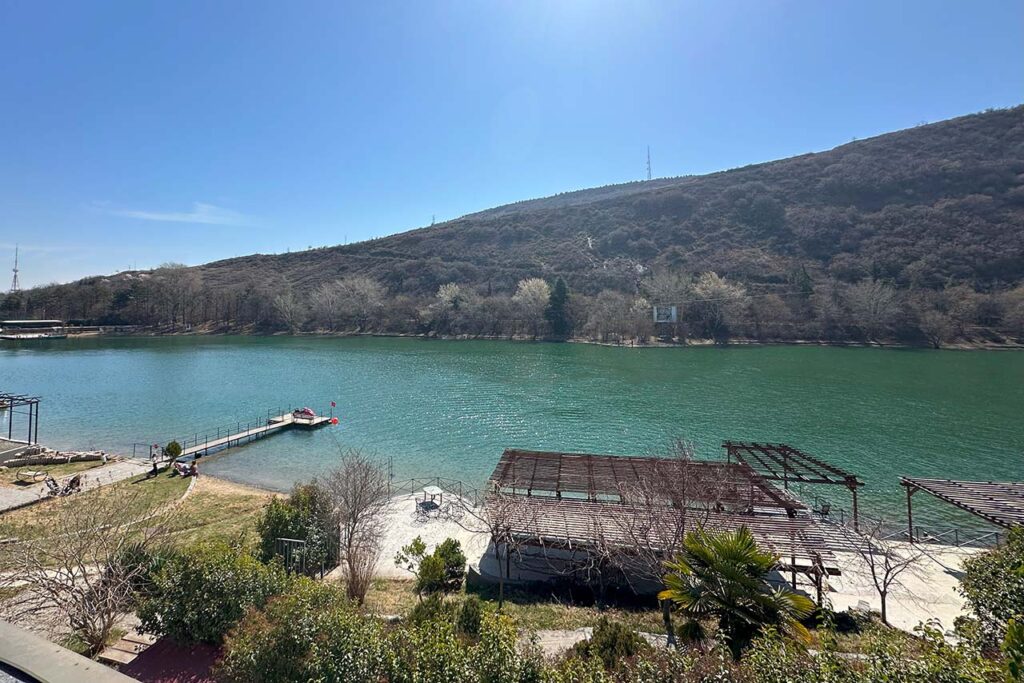
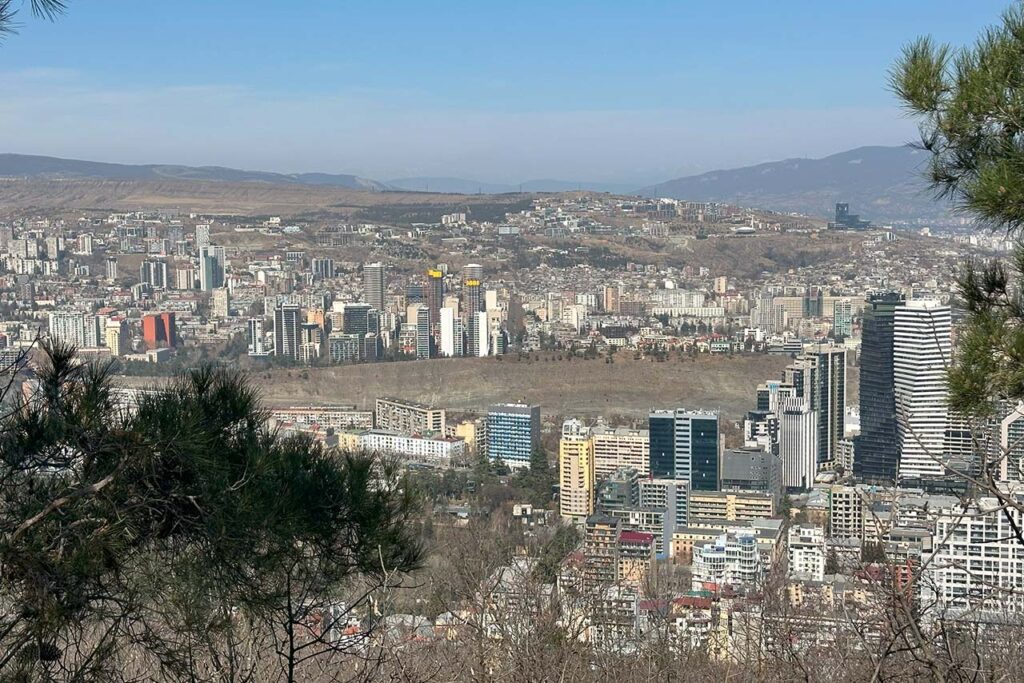
Turtle Lake in Vake Park is a quiet place for a family walk, with a cable car nearby. Tbilisi Sea is a big reservoir on the outskirts where people go to swim, sunbathe and grill shashlik. Above it stands the monument “Chronicle of Georgia”. The easiest way to get to the sea from the center is by taxi.



Option B. Green and spiritual Tbilisi
The big Botanical Garden lies right above the Legvtakhevi waterfall: ponds, little bridges, quiet, the city is almost inaudible. In the evening climb to Tabori church and watch the sunset: it is about a 25-minute walk from the Abanotubani area, and there are usually few people there. If you haven’t visited before, add Tsminda Sameba.


Option C. Non-touristy Tbilisi
“Chronicle of Georgia”, the zoo and shopping malls (Galleria Tbilisi on Freedom Square and Merani Mall). For souvenirs, look into the markets: the big Dezerter Bazaar by the railway station and the calmer Orbeliani Bazaar.


With children. Option A and the zoo.
Old Tbilisi in My Photos: Houses, Courtyards, Entrance Halls
This is not a route but a selection of shots from my walks around old Tbilisi: houses with carved balconies, entrances with ceiling paintings, courtyards.


Tbilisi Sights on the Map
How Many Days You Need in Tbilisi and How to Get Around
How many days to go. For first-timers, 2–3 days. Two days let you understand the city; the third is for relaxing and choosing to your taste. If you also want trips, add a day or two.
Underfoot in Tbilisi you come across round bronze plaques with “Tbilisi” written in Georgian and an eagle. Such plaques lie along tourist routes, and you can use them to find your way and stroll around the city.

Getting around. The center is on foot. Further out, metro and taxi. A Metromoney card is enough for the cable car to Narikala, while for Mtatsminda you need a separate park card, described in the Mtatsminda section.
Metromoney. The card is sold at metro ticket offices (2 lari), and you can top it up in the metro and at machines. Put money on it with a reserve so it’s enough for the metro, the bus and the cable car to Narikala.
Day Trips from Tbilisi
If you have already seen the city and want more, a day trip from Tbilisi is a good idea. If you plan to travel on afterwards: from Tbilisi to Batumi or to Yerevan.
FAQ: What to See in Tbilisi
What to see in Tbilisi in one day? Bridge of Peace and Rike Park, the cable car to Narikala, sulfur baths, the canyon with the waterfall, and an evening in Avlabar or on Rustaveli.
How many days do you need in Tbilisi? 2–3 days if you limit yourself to the city.
Where to go in the evening? To the Bridge of Peace, Narikala or Mtatsminda for a view of the evening city. Also bars and restaurants with live music.
What to see in Tbilisi with children? Rike Park, the cable car, Turtle Lake, the zoo.
Where to stay so that everything is close? In the center: Tbilisi districts, hotels in the center.

Hello!
I am Victor, the founder of this site and its main, but not the only author.
Traveler and photographer. Visited more than 60 countries.
Born and raised in Batumi. I love to travel in Georgia.
More about me here.