


Planning a trip to Georgia? It pays to know a bit about the local money before you go.
In short:
- the currency of Georgia is the lari (GEL), one lari is 100 tetri;
- bring US dollars or euros – every exchange office takes them, and the rate is good;
- you can’t pay in dollars or euros in shops, cafés or hotels – only in lari;
- VISA and Mastercard work almost everywhere;
- cash over 30,000 lari (about $11,000) has to be declared at the border.
What is the currency of Georgia: lari and tetri
The Georgian currency is called the lari. It’s an old Georgian word that means “treasure” or “wealth”. The name was suggested by the Georgian scholar V. Chantladze, who brought the proposal to the Georgian cabinet of ministers, and that’s how the national currency got its name. One lari is divided into 100 tetri. There’s symbolism here too: “tetri” means “white”. Coins come in 1, 2, 5, 10, 20 and 50 tetri, and there are also 1 and 2 lari coins.
Banknotes in use go from 5 to 200 lari. The 100 lari note is the one you’ll see most, while a 200 lari note is rare. The exchange rate is overseen by the National Bank of Georgia.
All the text on the money is in two languages, Georgian and English. The 200 lari note also has text in Abkhaz.
In 2016 brand-new 100, 50 and 20 lari notes went into circulation. They got extra security features and raised marks that help people with poor eyesight. The notes were designed by B. Malazonia.
Georgian money in photos
Coins

Banknotes. GEL – the Georgian lari
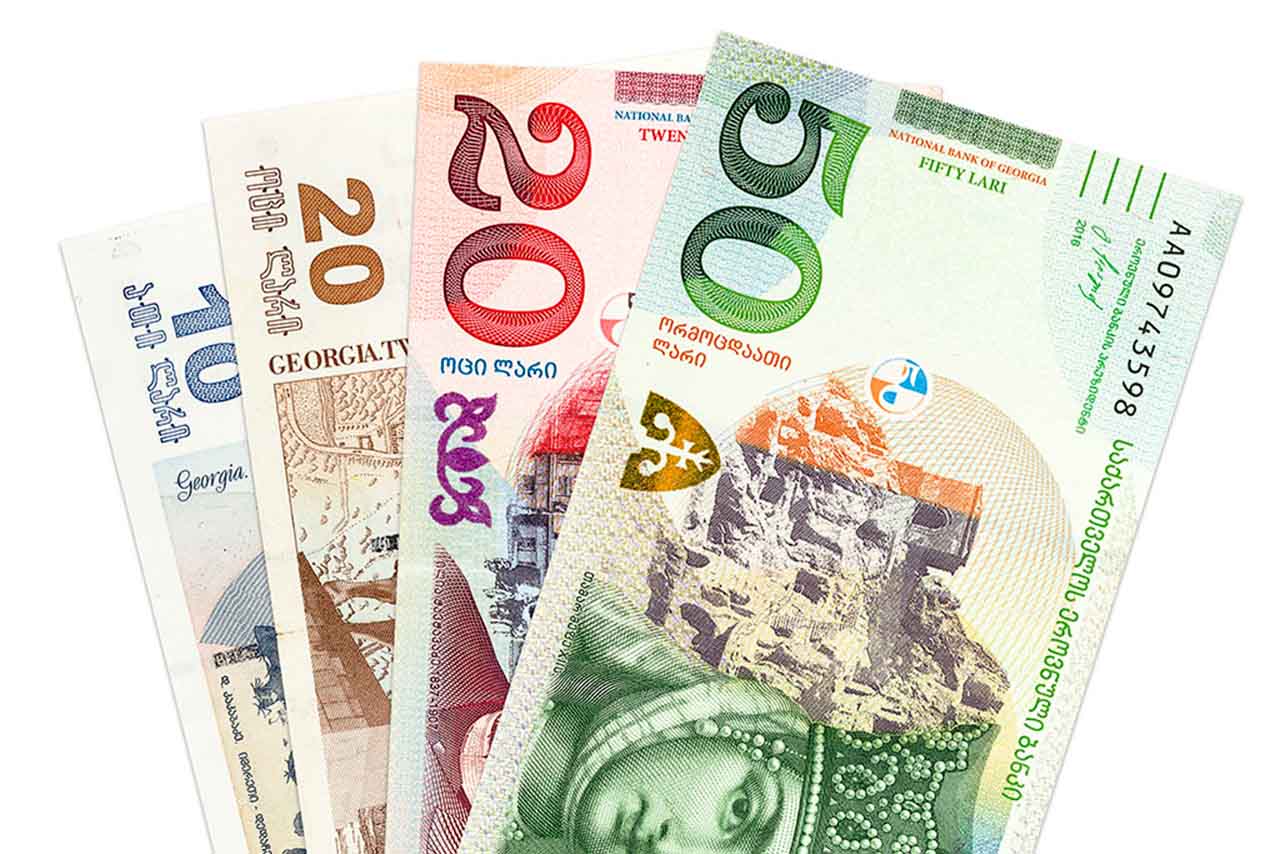
The lari was introduced in 1995, under Eduard Shevardnadze. Long ago money here was called abazi (after Shah Abbas), and from the middle of the 19th century Russian roubles were in use.
Lari exchange rate to the dollar and euro
To check today’s rate of the lari against the dollar, euro and other currencies, just look at the table below.
What currency to bring to Georgia
A lot of people ask what money to take to Georgia.
The best option is cash in US dollars or euros. Every exchange office takes them and the rate is good. Other currencies can usually be exchanged too, but the rate tends to be worse.
Exchanging money in Georgia
Exchanging the main currencies is no problem anywhere in the country: at the border, in private exchange offices in towns, at bus and railway stations and, of course, in the many banks. Banks are open from 9:00 to 18:00. Keep in mind they may ask for your passport or another ID when you exchange money. Private exchange offices ask for it less often.
The most popular chain of exchange offices in Georgia is Rico Credit. Their rate is good. Small exchange booths are sometimes a little better, but the difference is tiny. More on those below.
Here’s the Rico website with a map of their branches: rico.ge. They have branches all over the country, which is very handy.
The dollar-to-lari rate can vary a little from region to region, but the difference is small.
Note that under Georgian law you can’t pay in foreign currency in hotels, restaurants and so on. There’s a fine for it, and owners won’t take the risk.
Currency exchange in Tbilisi: where to get a good rate
In Tbilisi you’ll find exchange offices right next to the metro stations, and there are plenty at Tbilisi airport. I don’t recommend changing money at the airport, though: the rate there is poor. If you have to, change only what you need right away and the rest in the city.
A bad experience of my own:
There are a lot of private exchange offices in the Old Town. Be careful and count your notes right there at the window. Sometimes you run into dishonest ones who try to cheat tourists. It happened to me. I noticed the woman mixing different notes together. Usually they hand them over neatly sorted, but here tens and fives were mixed in between the hundreds. So I counted the notes twice, right in front of the glass, and 20 lari were missing. They gave me the missing money straight away. I didn’t even have to mention the police.
Later I found an exchange office in the Old Town with a good rate and professional service, and I changed money there every time after that. It’s on Pushkin Street, fifty metres from Freedom Square (GPS 41.695109, 44.802539), next to Café Warszawa and the footbridge over the Old Town fortress wall.
Photo of the exchange office with a good rate in the centre:

There are a lot of exchange offices around the railway station. If you walk from Station Square towards Dinamo Stadium and around the Dezerter Bazaar, you can easily find the best offer. There are lots of exchange offices in this area.
Currency exchange in Batumi
Exchange offices are all over the city, but the best rates are at the ones near the Batumi Plaza shopping centre. There’s a whole cluster of them in one place. A minute’s walk is enough to find the best offer, so that’s where I change money. I put the point on the map roughly in the middle, so it’s easier to see where this exchange street is.
Which cards work in Georgia
In Georgia you can use VISA and Mastercard without any problems, but Russian MIR cards and cards of Russian banks are not accepted. Almost all shops and most restaurants take card payments.
As for ATM fees, it depends on the bank that owns the ATM. On average in Georgia it’s about 2% of the amount.

You can bring any amount of money in your own currency – Georgia doesn’t limit it. But if your cash (together with cheques) is over 30,000 lari, which is about $11,000, you have to declare it both on arrival and on departure.
FAQ
What is the currency of Georgia?
The Georgian lari (GEL). One lari is 100 tetri.
What are Georgian coins called?
Tetri, which means “white”. Coins go from 1 to 50 tetri, plus 1 and 2 lari coins.
Can I pay in dollars or euros in Georgia?
No, by law you can only pay in lari. Exchange offices and banks will change your money in a couple of minutes.
Do bank cards work in Georgia?
Yes, VISA and Mastercard are accepted almost everywhere. Russian MIR cards are not.
How much cash can I bring into Georgia?
As much as you like, but anything over 30,000 lari has to be declared.
Georgia is waiting for its guests, and money is just a tool to enjoy everything it so generously has to offer!
Read more:
The most interesting and unusual hotels in the mountains of Georgia

Hello!
I am Victor, the founder of this site and its main, but not the only author.
Traveler and photographer. Visited more than 60 countries.
Born and raised in Batumi. I love to travel in Georgia.
More about me here.