


Georgia is one of the most unique regions on the planet. This small territory holds almost every natural zone there is, from lowlands below sea level to mountain ridges where the snow never melts. Deserts, swamps, forests, steppes, lakes and rivers: nature clearly did not hold back here. One of the most original natural areas, with primeval relict forests, is Sataplia (the “honey place”). South-western Georgia is often called the land of green mountains, and in Sataplia you understand what that really means.
Sataplia Nature Reserve: ticket prices and opening hours (2026)
Sataplia (Georgian for “the place where there is honey”) is a nature reserve near Kutaisi. In short, here is what you need to know before you go:
- Where: Imereti region, near Kutaisi and not far from Prometheus Cave.
- Entrance: 30 GEL for adults, 5.5 GEL for children from 6, free under 6. A guided tour is included in the ticket.
- Opening hours: from 10:00, until 18:00 from May to August and until 17:00–17:30 the rest of the year.
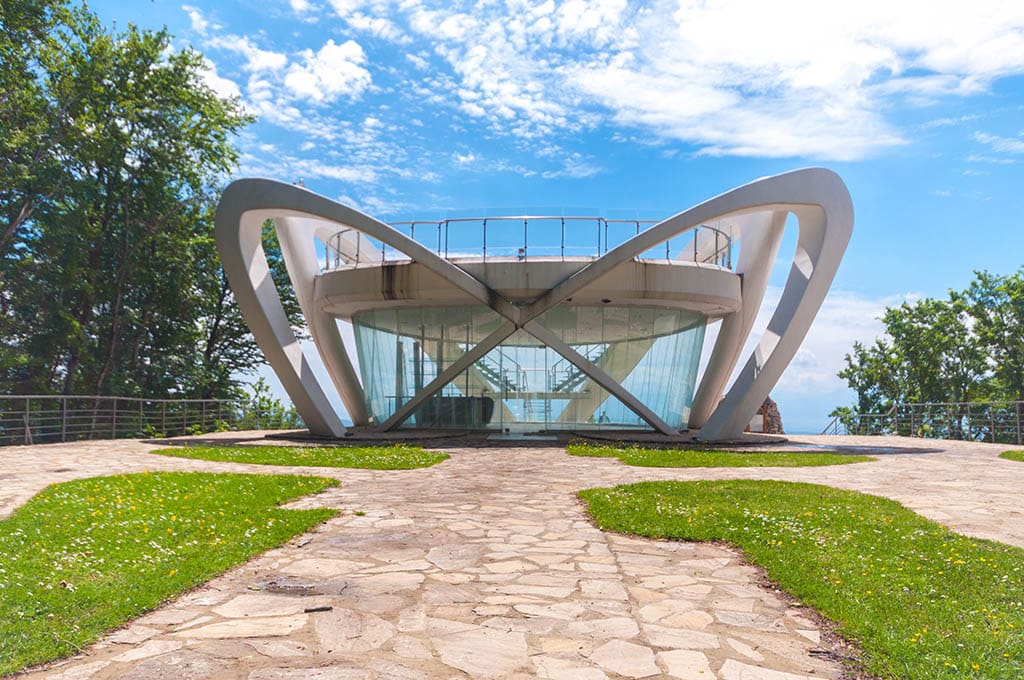
- What to see: dinosaur footprints in a pavilion, Sataplia cave with its stone heart, a glass-floored viewing platform and the Colchic forest.
- Weather: the viewing platform is closed in rain and snow, so go on a clear day.
- What to bring: a sweater, as the cave stays at +14°C in winter and summer alike.
Sataplia or Prometheus Cave?
Prometheus Cave is bigger and more spectacular, but it is crowded and the groups move fast. Sataplia is calmer, and besides the cave there are dinosaur footprints, the forest and the glass platform. It is also easier with small children. If you have time, do both: they are very close to each other.
Sataplia, Georgia: a prehistoric background
All this diversity and richness is probably why signs of life appeared so early on the territory of today’s Georgia. Excavations carried out at different times have revealed more than four hundred sites showing the presence of life here in the Cretaceous, Jurassic, Palaeolithic and other eras.
Traces of the Palaeolithic can be found almost all over the country: in the west, east, south and on the northern slopes. One of the most important finds is the remains of early humans discovered in Dmanisi. They are about 1.8 million years old and are the oldest human remains found outside Africa.
Palaeolithic sites have also been found:
- in Abkhazia, at the Yashtukh site-workshop;
- in Tsona cave (South Ossetia);
- in Tsopi cave;
- in Javakheti and elsewhere.
Dinosaur footprints in Sataplia Nature Reserve
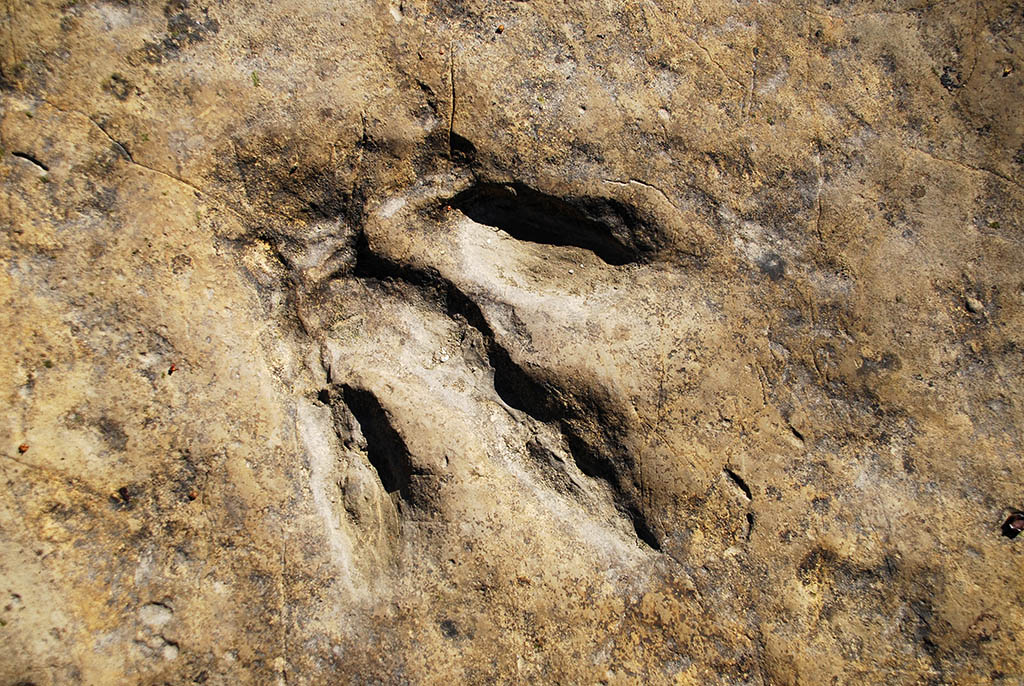
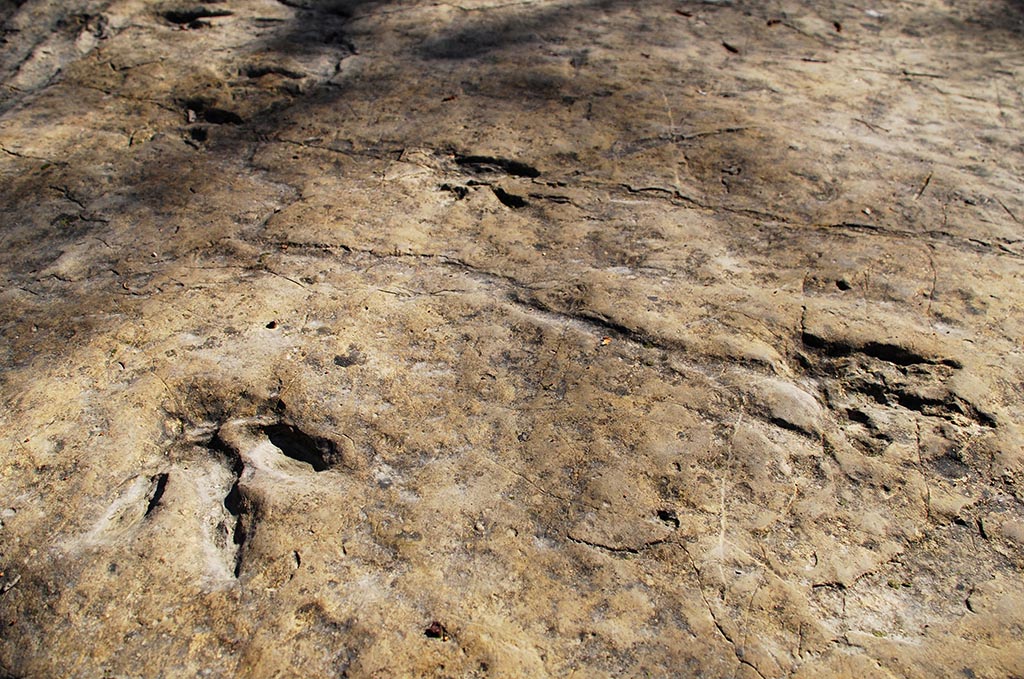
But the most remarkable and ancient find in Georgia was the discovery of footprints in limestone near Kutaisi in 1933 by Petre Chabukiani, a history teacher, naturalist and local historian. During later excavations, palaeontologists found a new layer of limestone with footprints of other dinosaurs. The difference between the first and second layers could be 50 million years. The footprints turned out to be unique, between 200 and 150 million years old.
They are unique not only because they are perfectly preserved in once-soft limestone, but also because footprints of both herbivorous and predatory dinosaurs were found in the same place.
Scientists say that many millions of years ago this spot was a limestone seashore where giant lizards ran. At first the shore was bare, which is why predator footprints were found here: perhaps they hunted on the coast. Fifty million years later the water retreated, trees and other plants appeared on the fertile soil, and that attracted the herbivores.
All the dinosaur footprints found elsewhere in the world belonged either to herbivores or to predators, and only in Sataplia do you find, almost side by side, herbivore footprints that look like an elephant’s and predator footprints that look like bird tracks.
After Petre Chabukiani discovered the footprints, the limestone stayed in the open air for a long time, exposed to rain, wind and bright sun.
Only in 2010, when the country started paying serious attention to tourism, was a pavilion built over the footprints, together with a tourist trail and proper lighting.
Today the dinosaur footprint pavilion is the first sight of Imereti’s “Jurassic Park” in Sataplia. Visitors can light up the footprints and listen to a guide or an audio guide, while sounds resembling the roar of prehistoric lizards play in the pavilion.
Honey Rock (the bee cliff)
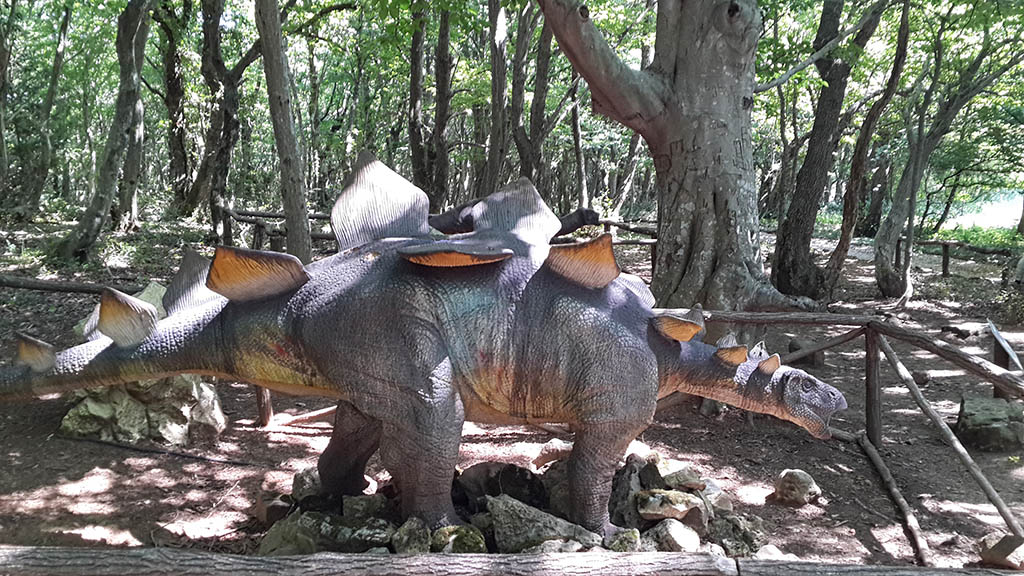
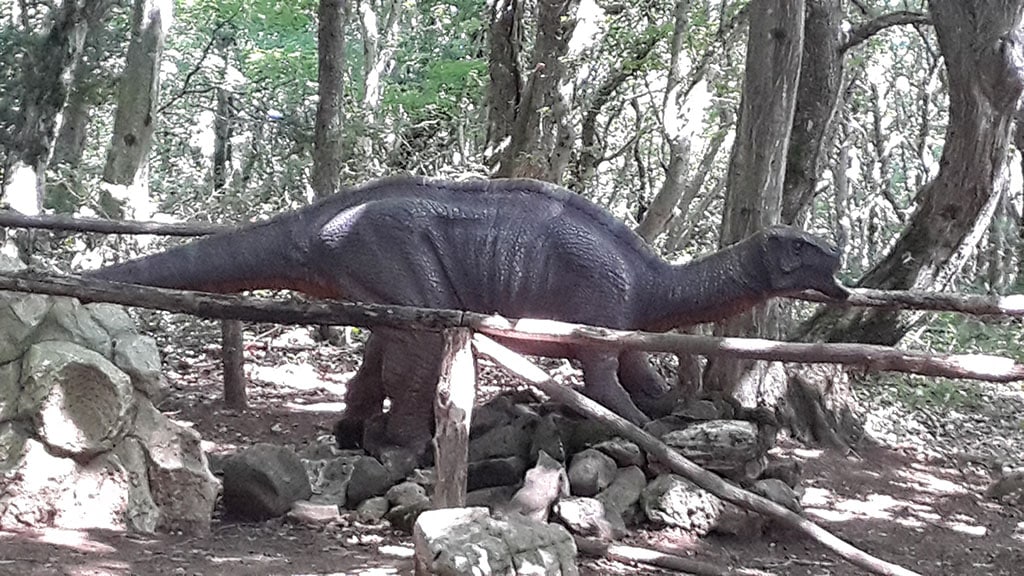
On the way to the next sight, Honey Rock, visitors pass life-size dinosaur models along the trail and can take photos with them. Children love touching them and posing next to the dinosaurs.
Honey Rock is another sight of the Imereti region. Local people used to collect natural honey from this rock, made by the swarms of wild bees that loved this place. The whole rock is still covered in small hollows left by the bees.
Even today you can see a few bees flying in and out of the rock.
Opposite Honey Rock there is a small viewing platform that prepares you for an even more breathtaking sight: a bird’s-eye view of Imereti.
Sataplia karst cave and the stone heart
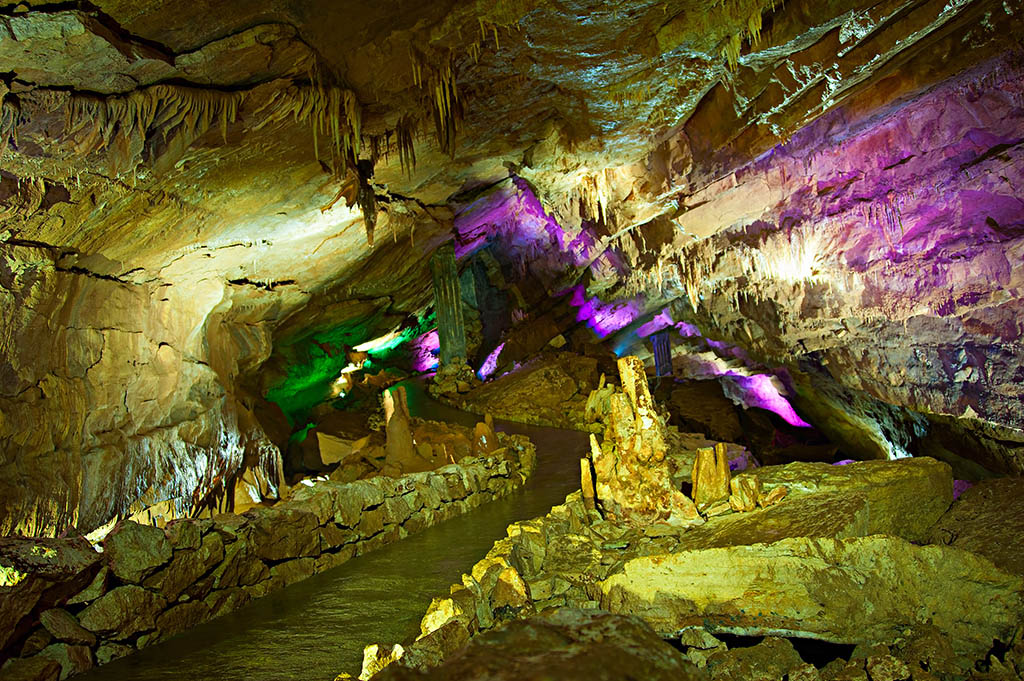
After Honey Rock, the trail leads to a karst cave, also discovered by Petre Chabukiani in the first half of the last century, when he followed a stream that disappeared into a crevice.
In 2010, when the tourist area in Sataplia was being created, German specialists were invited and built a 300-metre illuminated trail in one of the five karst caves.
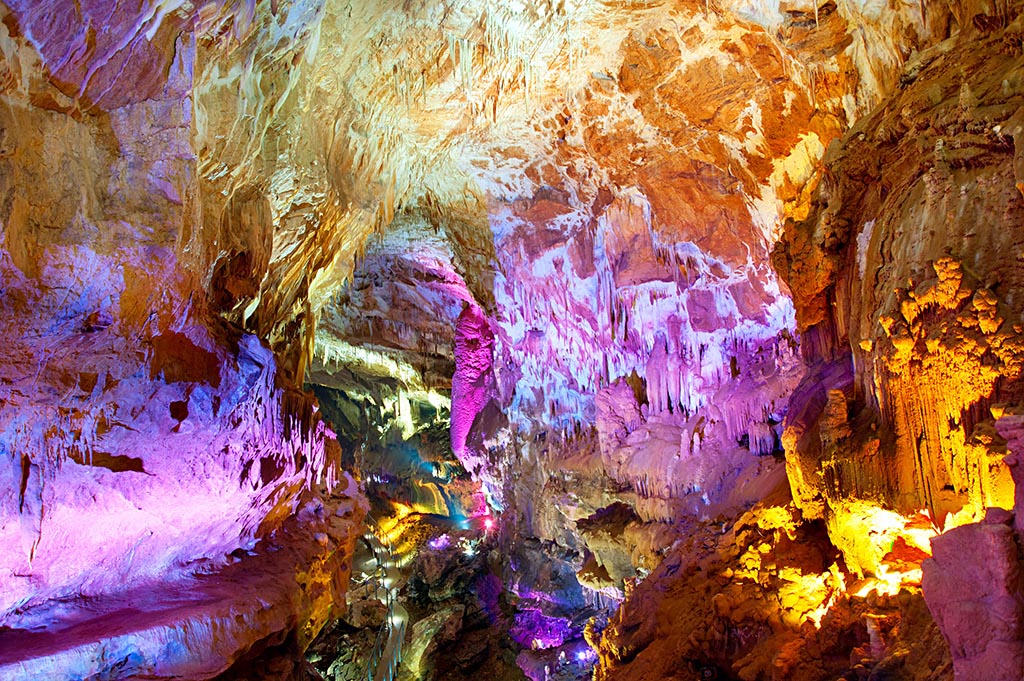
Imereti has many karst caves formed by underground water washing out soft rock. The most popular is Prometheus Cave, which is worth visiting after Sataplia.
But even the short route through the Sataplia cave can leave a lasting impression, especially on children. If you are lucky, you may see bats, which live in the caves.
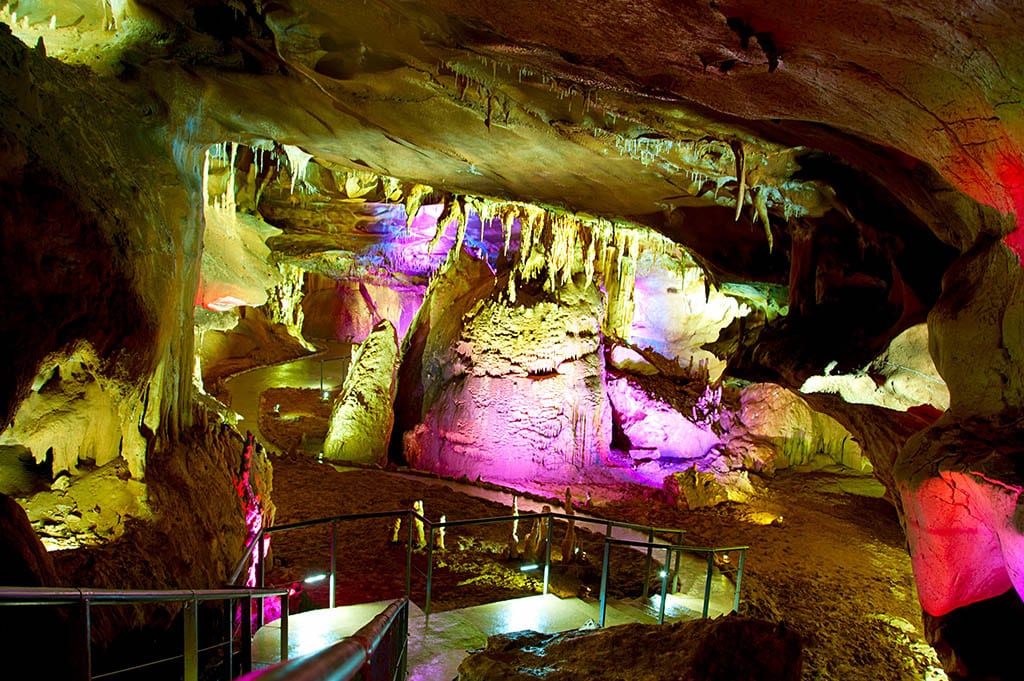
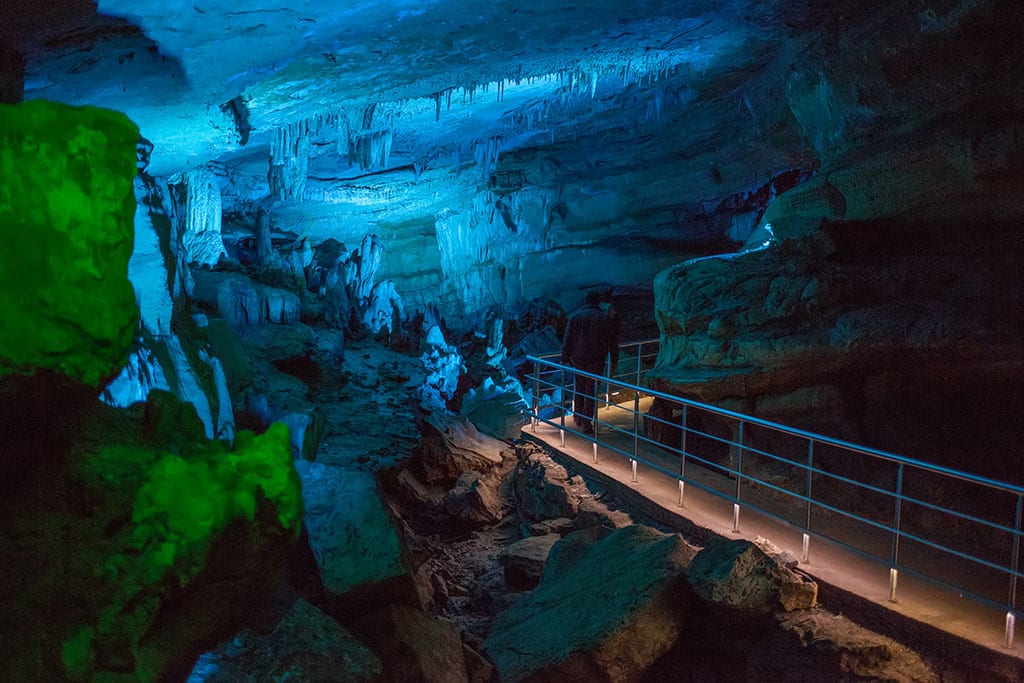
The underground world along the trail has multicoloured lighting that brings out the beauty of the many stalactites, stalagmites and stalagnates.
As you would expect, the cave has its own tourist highlight: a stalagmite that looks like a huge heart-shaped boulder. Visitors put their hand into its hollow, and according to legend, a wish made at that moment will come true.
Underground water drips onto this “heart” and makes it grow by 1 cm every thousand years. Knowing this helps you understand how many millions of years it took for crystallised limestone to form the stalactites, stalagmites and stalagnates.
It is hard to stay in the cave for long, as the temperature is a constant +14°C in both winter and summer.
Glass viewing platform (the crystal bridge)
Apart from the footprints, no other traces of dinosaurs have been found in Sataplia, so the skeleton is an artificial model.
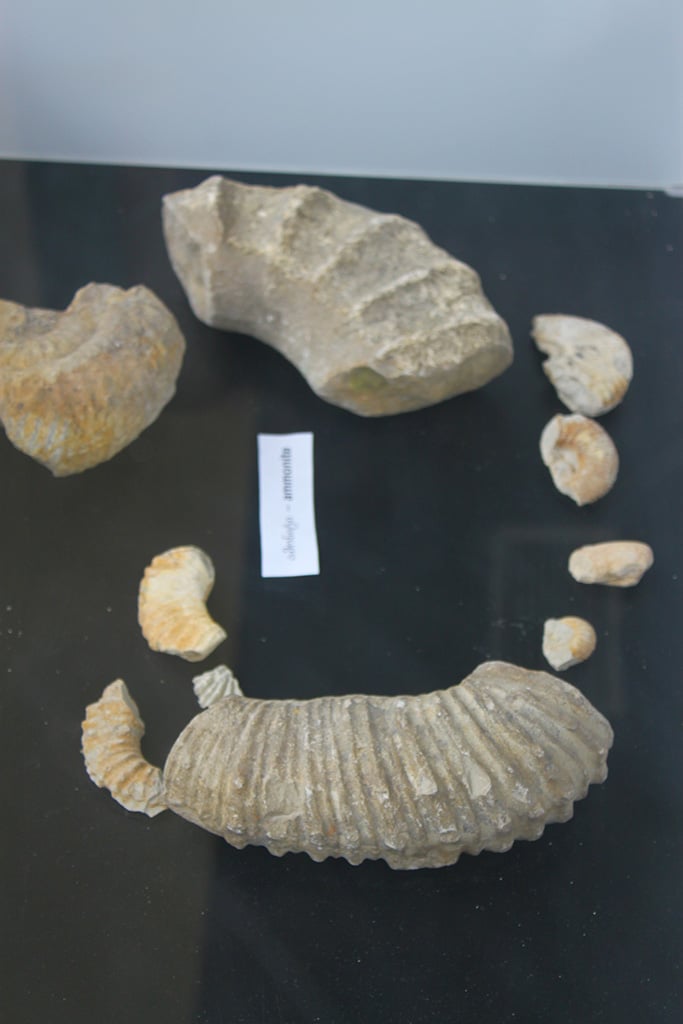
If you are lucky, you can buy a souvenir in the museum: a cast of an ancient lizard’s footprint.
The climb to the viewing platform can be tiring, so there are benches along the way where you can rest.
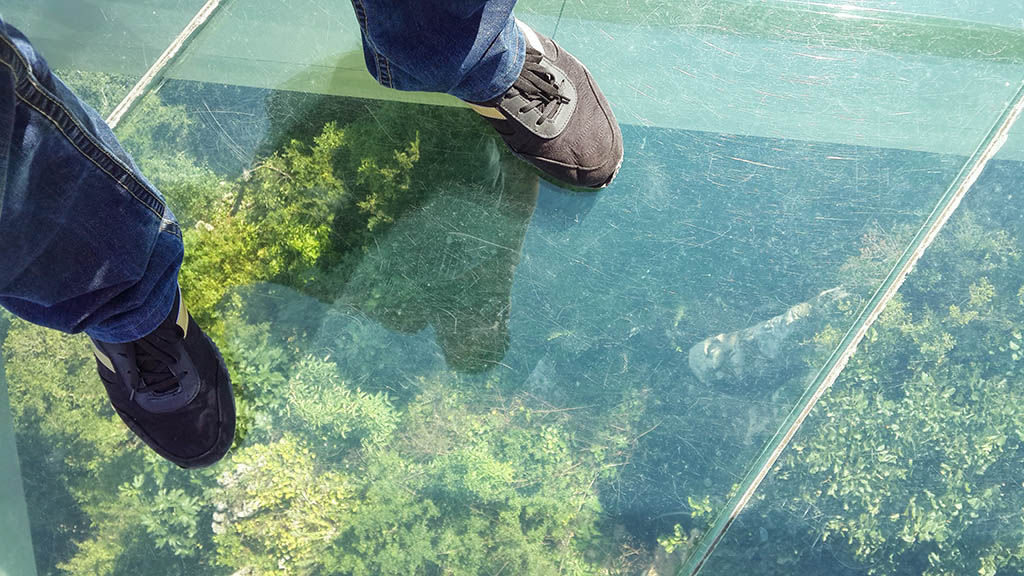
The viewing platform is horseshoe-shaped and hangs over a precipice. Its floor is made of thick, semi-transparent glass, and visitors are asked to wear special slippers so as not to scratch or dirty it.
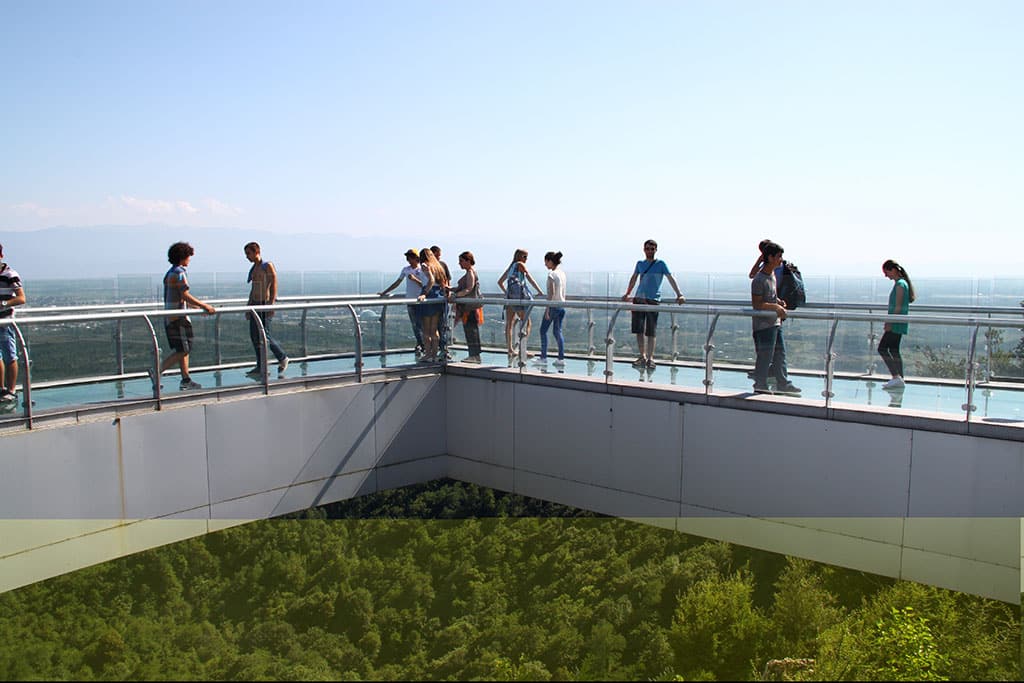
For people who are really afraid of heights, the platform makes a strong impression.
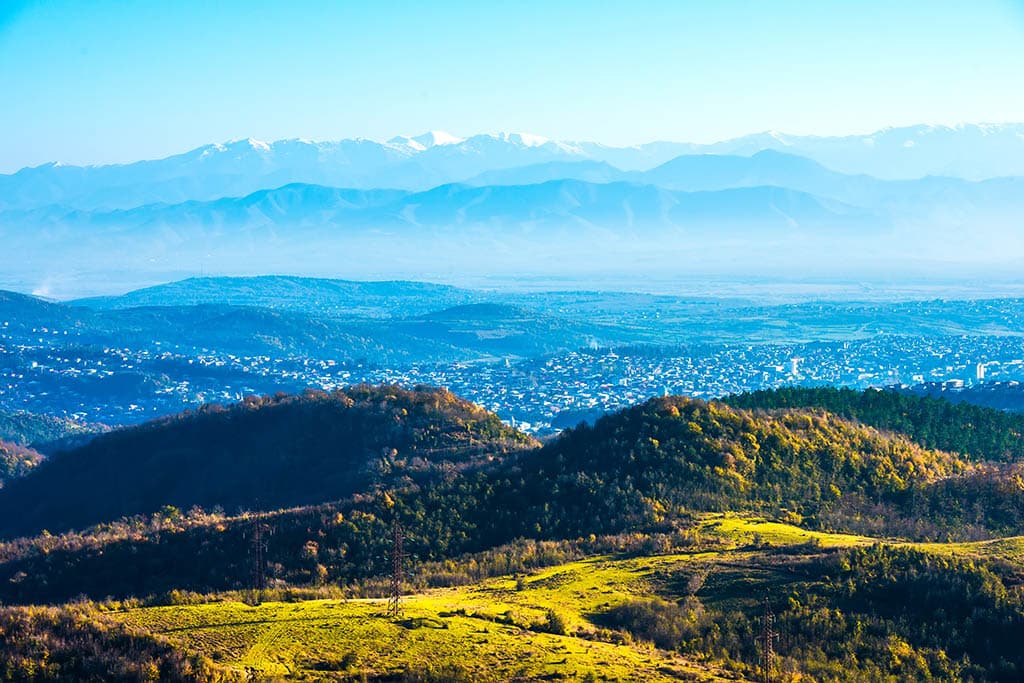
From the edge you can see the lovely landscape of Imereti covered in deciduous forest. The view is especially charming in late autumn, when the trees form a colourful palette of golden autumn.
In clear weather you can see Kutaisi, with the domes of Gelati Monastery and the rebuilt Bagrati Cathedral rising nearby.
After the cave, the guides leave the visitors to walk on their own. The viewing platform is basically the end of the visit, but if you are not in a hurry, you can also walk through the relict Colchic forest, which surrounds the whole route after the last village.
The Colchic forest in the reserve
The Sataplia tourist complex is located in a nature reserve of the same name covering 354 hectares. From the start of the dinosaur trail to the very end, you are accompanied by the unique relict Colchic forest, which is found nowhere else.
The Colchic forest consists of relict trees that once grew in Europe. The Sataplia reserve has preserved trees such as Caucasian boxwood, holly, bay laurel, beech, Caucasian walnut, sweet chestnut, rhododendron and hornbeam. The trees grow densely, and many are entwined with ivy and evergreen vines.
One feature of the Colchic forest is that no grass grows under the trees. The reason is simple: the trees grow up to 40 metres tall and their crowns let almost no sunlight through. In summer you can find plenty of milk-cap mushrooms among the tangled roots, and picking them for personal use is allowed.
Almost every tree in the Colchic forest has valuable wood, which led to mass logging. Boxwood suffered most, as it grows very slowly: in 500 years it cannot even reach 20 metres, and it thickens just as slowly.
Dense boxwood resembles ivory, and its growth rings are almost invisible on a cut. Freshly cut boxwood sinks in water. Legend even says that Noah’s Ark was built from it. The Sataplia reserve has boxwood trees more than 1,000 years old.
The reserve has quite a rich wildlife, as hunting is strictly forbidden.
How to get to Sataplia, prices and opening hours
The Sataplia tourist complex is 7 km from Kutaisi, the ancient capital of the Imereti kingdom. It is 220 km from Tbilisi, about 3 hours by car, and the roads are in excellent condition.
By public transport, minibuses to Kutaisi leave from Didube bus station and the station square in Tbilisi, and also from the airport. A car or a minibus is the most convenient option if you travel on your own.
The minibus ride from Tbilisi may feel a bit extreme, but it is safe: the drivers like to go fast, but accidents are very rare.
In Kutaisi you can hire a taxi. The driver will take you there, wait as long as needed and bring you back.
From Batumi, it is easiest to get to Kutaisi first and continue by local taxi.
Before planning your trip, note the opening hours: the reserve opens at 10:00 and closes at 18:00 from May to August and at 17:00–17:30 the rest of the year. On rainy and snowy days the viewing platform is closed.
Ticket prices:
- adults: 30 GEL;
- children from 6: 5.5 GEL;
- children under 6: free.
The ticket includes a guided tour.
If you travel on your own, there are plenty of other sights around Kutaisi worth combining with Sataplia:
- Gelati Monastery, where the kings of Imereti are buried. It was founded by King David the Builder in 1106 and is a symbol of Georgia’s Golden Age;
- Motsameta Monastery, a beautiful place with an equally beautiful legend;
- Bagrati Cathedral, rebuilt on the site of the ruined church;
- Prometheus Cave, a stunning karst cave where you can take a boat along an underground river;
- the White Bridge in Kutaisi, with a lovely view of the river flowing over white stones.
Not far from Kutaisi you can also visit Okatse Canyon with its beautiful waterfalls, and in the neighbouring district the Katskhi Pillar, with a hermit’s hut and an old monastery on top.
Sataplia Nature Reserve FAQ
How much does it cost to visit Sataplia?
30 GEL for adults, 5.5 GEL for children from 6, free for children under 6. A guided tour is already included.
What are the opening hours?
From 10:00, until 18:00 from May to August and until 17:00–17:30 the rest of the year. The glass viewing platform is closed in rain and snow.
Can I visit Sataplia with children?
Yes, kids love the dinosaur models and the cave. But there are lots of steps and climbs, so a pushchair will be hard work.
How do I get to Sataplia cave?
The easiest way is to get to Kutaisi first and take a taxi from there. The road to the reserve is good, any car will do, and there is a car park at the entrance.
Read also: Prometheus Cave, Top 15 attractions in Georgia.

Hello!
I am Victor, the founder of this site and its main, but not the only author.
Traveler and photographer. Visited more than 60 countries.
Born and raised in Batumi. I love to travel in Georgia.
More about me here.