


In mountainous country, right on the bank of the picturesque Potskhovi River and surrounded by majestic ridges, lies the town of Akhaltsikhe. This small town (about 18,000 people) is the centre of an amazing region of Georgia, Samtskhe-Javakheti, as the south of the country is called. It is like an ancient “island” that draws tourists, and no wonder: here you come across the rich heritage of different peoples. The region borders Armenia and Turkey to the south, Adjara to the west and Kvemo Kartli to the east.
Akhaltsikhe: the trip in brief (2026)
Akhaltsikhe is the main town of Samtskhe-Javakheti in southern Georgia, about 210 km from Tbilisi. In short, here is what you need to know:
- Main sight: Rabati Fortress. The lower part is open around the clock and free; entrance to the upper part costs 18 GEL.
- What else to see: the church and monument of Queen Tamar, the Jewish quarter with its old synagogues, and the Catholic monastery on the Northern Heights.
- Nearby: Sapara Monastery (about 10 km), the cave city of Vardzia and the spa town of Borjomi.
- How much time you need: a day for the town itself, 2–3 days with the surroundings.
- Money: apart from Rabati, almost every place can be visited for free.
History of Akhaltsikhe
The “fate” of Akhaltsikhe has been very dramatic: for centuries bloody wars raged here, and the town passed from one state to another. It used to be called Lomsia and belonged to the famous princely Jakeli family (900 AD). The warlike members of the clan constantly provoked armed conflicts, trying to break free of the central government.
But Tamar, Queen of Georgia, ended the conflict by pacifying the warring princes and handing the town to another branch of the same Jakeli family. This family produced the famous commander Shalva Akhaltsikheli, later canonised.
For about 300 years the town was the capital of the Principality of Samtskhe, which declared independence. But in the late 16th century the Turks conquered it and ruled the area for a long time. In 1828 the town was besieged by the Russian army, which drove out the invaders. In the 19th century many Jews and Armenians settled here. In 1918 Akhaltsikhe was attacked by the Turkish army, which held it for several months.
What to see in Akhaltsikhe
Rabati Fortress (Akhaltsikhe Fortress)
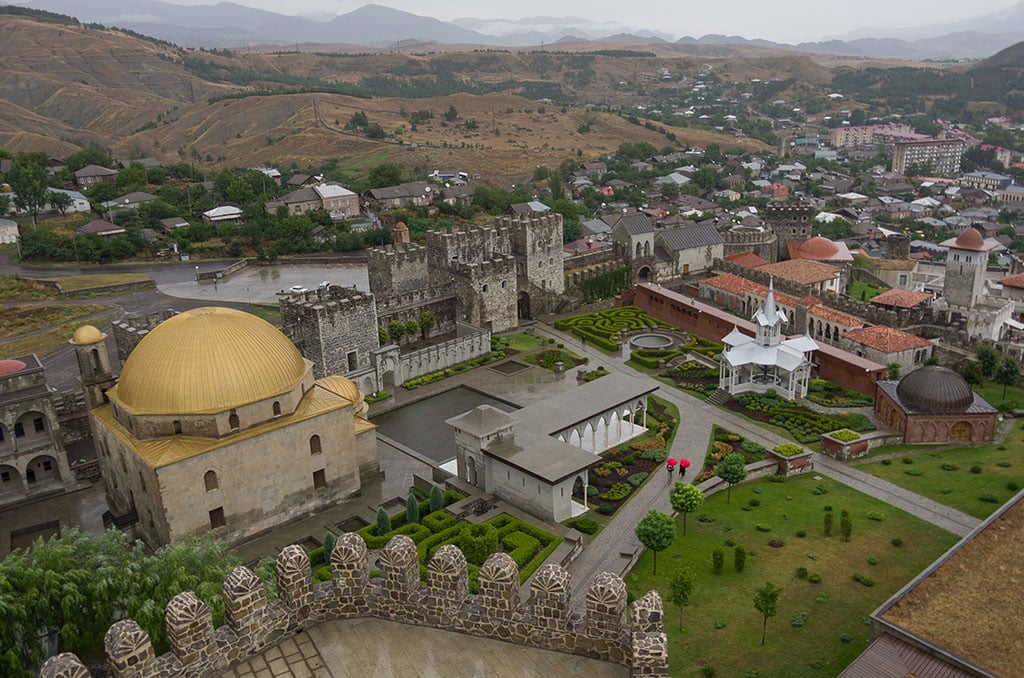
The town’s main sight stands on a hill in the centre. The lower part of the fortress is a public area where you can admire the buildings, the towers and the huge walls. Entrance is free.
The lower part has a nice hotel, Rabati, and the KTW wine shop with a great choice of drinks.
The upper part of the fortress is a museum area. It holds the Akhmediye Mosque with its gilded dome, the Jakeli Castle, an Orthodox church and a history museum. Entrance to the upper part costs 18 GEL (less for locals). The lower part is open around the clock and free; the upper part is open during the day and closes at 17:30.
Tourist information office
It is right inside Rabati Fortress, at 1 Kharischirashvili Street. A friendly manager will always welcome you, give you a town map, sell tickets to the museum part of the fortress and tell you where to find other sights of Akhaltsikhe.
Georgian Catholic monastery
The northern part of the town is “guarded” by a mountain rising to 1,120 m, a natural fortification called the Northern Heights. You can get there by taxi on a dirt road, just 15 minutes from the centre. The mountain is very picturesque and covered with trees; you can have a picnic and admire the town from above.
The main sight here is the Georgian Catholic monastery. It was built at almost the same height as Rabati Fortress, which sealed its fate: in 1828 fierce battles between the Turks and Russians took place here and the monastery was almost destroyed. Today a new monastery in the Benedictine style stands on the site of the old one, and the old heritage is recalled by gravestones with amazing ornaments in the yard. The Turkish bastion was almost completely wiped out, and a new building stands in its place. Entrance is free.
Armenian church
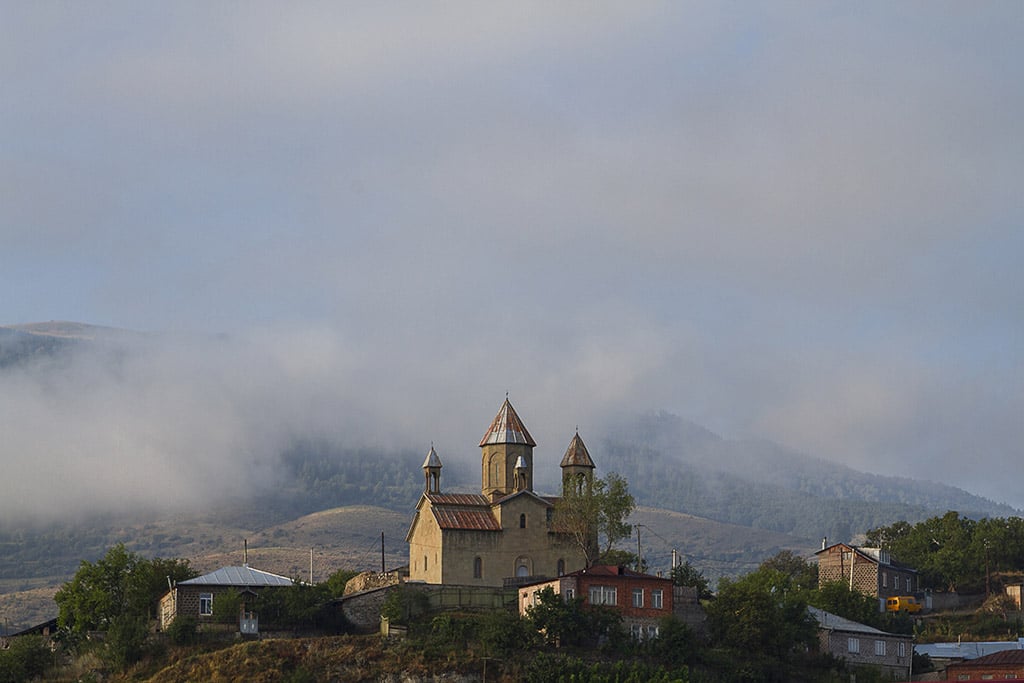
From the Northern Heights you can also see another, badly ruined church. It is said to have belonged to Armenians, though its name has not been established. It was probably built in the 18th century. Today only its walls, gable roof and semicircular wooden vault remain. Nearby stands a small bell tower (on the west side) with a wooden dome. The old church stands on the slope of the town’s Eastern Ravine, with views of Akhaltsikhe and the Northern Heights, and in winter of the snow-covered Turkish ranges.
You have to walk: from Rabati Fortress head to Kazbegi Street, walk its whole length and then go up a dirt road. The walk takes about an hour. Entrance is free.
Church of St Marina (Marine)
West of the fortress, on a high hill, stands this church. The Orthodox church was built in the late 19th century on the site of an older one. Its appearance is unremarkable; visitors come for its relic, fragments of the relics of St Marine kept here. The interior is modest but refined, with painted icons on the walls, and a tall bell tower stands nearby. Though active, the church is often closed (entrance is free). You can walk there from the fortress, heading west, in about 30–40 minutes.
Ruins of the Turkish baths
Heading north-west from the fortress, before you reach the Catholic monastery, you can see the “legacy” of the Turkish conquerors: the famous baths. Today they are simply large grey domes rising above the ground. Two brick half-vaults look like a single building with a façade, hinting at an earlier church. It is said the baths were built right on the foundations of a Christian church, from its debris. The area is overgrown with grass, but the town plans to restore the buildings and open a museum. Entrance is currently free.
The Jewish quarter and synagogues of Akhaltsikhe
This small district is tucked away in the old part of town beyond the Eastern Ravine. Many Jews used to live here, but today almost all of them have left, and Armenians have moved in. Visitors come for the two old synagogues.
The Old Synagogue of Akhaltsikhe was built under the Turks in the 1740s. Be sure to visit this ancient monument and admire its architecture. The synagogue is not active, and visiting is free; a restoration and museum are planned. How to get there: head east from the fortress along Guramishvili Street; the Jewish quarter starts on the left. Not far from the old building, heading south, a second synagogue was built in 1865; it is still active today, and visiting is free.
If you want to see the old Jewish cemetery, head north from the synagogues: it is right behind the Armenian cemetery. It is hard to get in, though: the Jewish graves are surrounded by a high fence and the gates are almost always locked. You would have to climb over, but it is worth it: huge sarcophagi, “stone chests” and beautiful monuments.
The church and monument of Queen Tamar
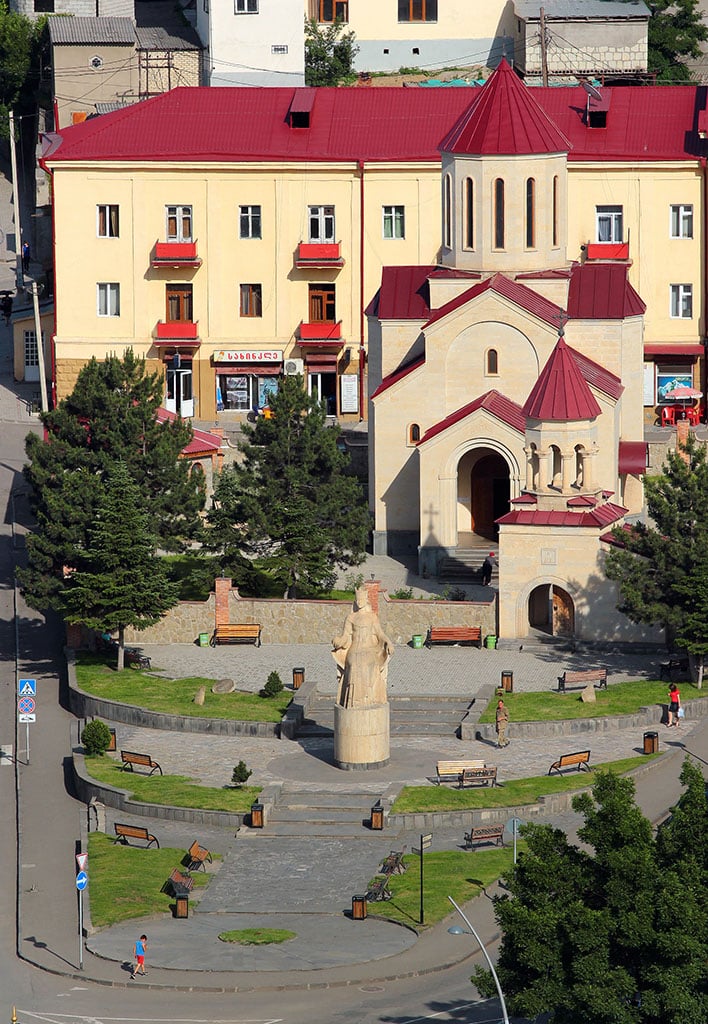
Of course, Akhaltsikhe has a monument and a church dedicated to this iconic figure. The queen did a great deal for the ancient state and for the town in particular: it was she who handed it to the Jakeli family, who were able to resist many invaders.
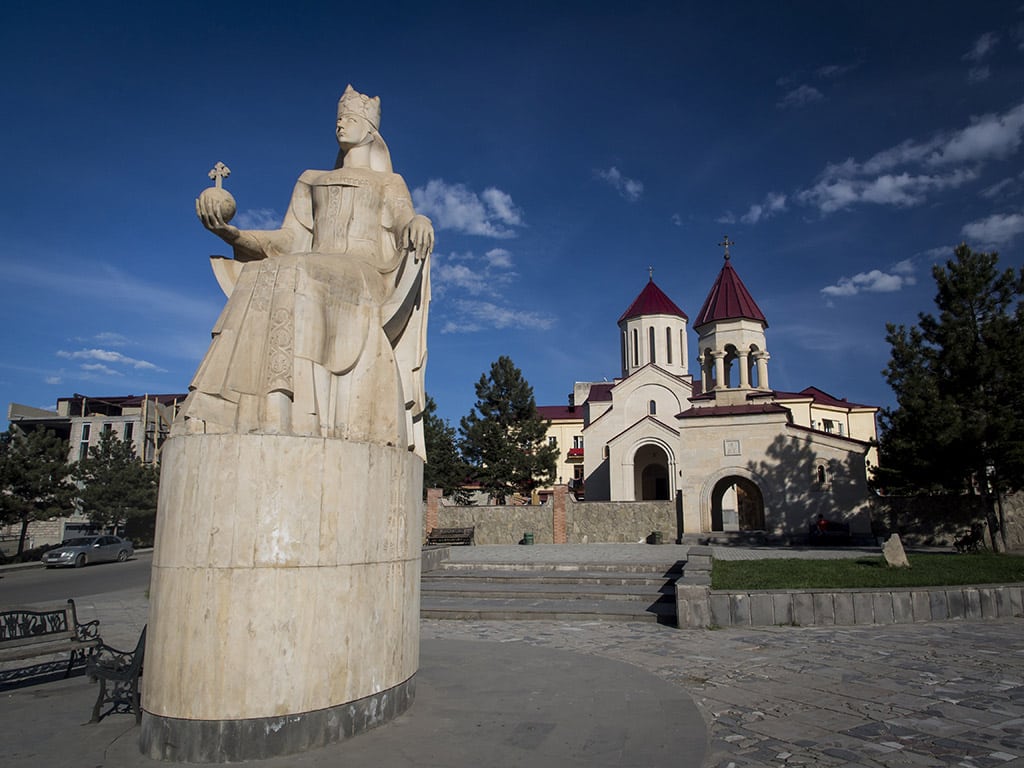
Queen Tamar’s Church (built in 2009–2010) is a small monumental building in light colours. The interior is restrained; the iconostasis in the centre deserves special attention. The altar shimmers with gold, and the walls bear traditional paintings of Tamar and other important figures of Georgia. In front of the church is a huge monument to the queen, seated on a throne holding a symbol of power. Both are on Kostava Street, just 500 m from the centre and the fortress.
What to see near Akhaltsikhe
About an hour and a half from town is the cave city of Vardzia, and about an hour away is the spa town of Borjomi. We have separate articles about them; here we will tell you about a monastery many people miss.
Sapara Monastery
If you come to Akhaltsikhe, be sure to visit this amazing monastery complex just 10 km from the town centre. Several buildings have survived. The oldest is the Church of the Dormition (10th century), decorated with ancient columns. Next to it is a 13th-century domed church. On the hillside you can see a fortification with three surviving towers and a low stone wall. The lower part of the slope is crowned by the ruins of old cells carved right into the rock and lined with stones.
Nearby is the largest church of the complex, the Church of St Saba (13th century), with two small buildings beside it. Interestingly, all the churches have heavy stone slabs instead of roofs, and so does the main dome over the bell tower.
It is best to go by taxi: there are no direct buses from the bus station, so agree with the driver straight away that he will wait at the monastery and take you back.
There is another option: a hike. From the town centre walk about 2 km east along Rustaveli Street. At its end is a turn to the village of Khreli (there are no signs, but you will see the village from the road). You have to climb steeply up a dirt road to a big slope. After 2.5 km you reach a picturesque pass with a great panorama of the mountains, the surroundings and Akhaltsikhe itself. Just beyond the pass is the village of Khreli, where you can drink delicious spring water and breathe in the scent of the pine forest. From the village it is another 3 km to the monastery along a flat road. Visiting is free.
Getting around Akhaltsikhe
The Potskhovi River (a tributary of the mighty Kura) flows through the town. The river and the busy highway divide Akhaltsikhe into two large districts: the hilly northern left bank and the flatter southern right bank.
The town’s main landmark is Rabati Fortress. Next to it is a small square that serves as a traffic junction.
The main road, Tamarashvili Street, runs right below the fortress hill, and the bus station is on it. From the square you can turn under the railway bridge and find yourself on the hill at the entrance to the fortress. To reach the right bank, cross the Potskhovi bridge onto Kostava Street, a 15-minute walk. On the way you will pass a small square with the monument to Queen Tamar and her church. Go round the church on the left and you are on Didimamishvili Street; Rustaveli Street runs parallel to it (from there you can drive to Vardzia).
If you walk straight along Kostava Street and turn left, you reach Natanadze Street; after 100 m you will find the post office, with a park behind it.
Walk round the park to see the Drama Theatre, behind which is the police building (Rustaveli Street).
From the square along Kostava Street, walk 100 m and turn right onto Ladze Street to reach the local market. It is always lively, with plenty of dairy products, cheeses, wines, clothes and souvenirs. You can haggle: sellers are happy to talk to tourists and give good discounts, especially on seasonal fruit and vegetables. Walk another 350 m along this street and you will reach the Armenian church.
After a pleasant tour, take care of your accommodation: there are not many hotels and guesthouses in Akhaltsikhe, but they are quite decent.
When is the best time to visit Akhaltsikhe
The best time to travel is spring. Everything is in bloom and the mountain peaks are covered in snow. There is little rain here, but cold northerly winds often blow. In April–May the weather is great, with temperatures of 18–25°C, and you can admire huge poppy fields on the mountain slopes.
Summer is hot, and in July the temperature sometimes reaches 30–35°C. By late August sightseeing becomes comfortable again: no heat, you can easily climb the hills and mountains, and temperatures stay around 25–28°C.
Autumn brings magnificent views: the mountains turn yellow and red, and green firs complete the picture. A light haze wraps the ridges, and the air smells of forest. Akhaltsikhe is a very clean and hospitable town, and people are easy to talk to and ready to explain everything even if they do not speak your language. A special feature for tourists: there are very few places you have to pay for, so you can save a lot. The ideal stay is 2–3 days, enough to see the town and its surroundings.
How to get to Akhaltsikhe from Tbilisi, Batumi and Kutaisi
Akhaltsikhe on the map of Georgia:
The town’s bus station is right in the centre, and all buses and minibuses leave from it. Address: Tamarashvili Street, tel.: 593-71-70-47.
Getting to Akhaltsikhe by train is not very convenient, as most trains bypass the town. It is better to go by bus:
-
- From Tbilisi: minibuses leave the bus station at Didube metro roughly every 40–50 minutes, and the ride takes about 3–3.5 hours.
- From Batumi the most convenient way is by car. There are also direct minibuses, several a day, taking 4–6 hours; check the schedule at the bus station. Without a direct service, change in Kutaisi or Borjomi.
- From Gori: about 2 hours.
- From Kutaisi and Zestafoni: about 2.5–3 hours.
Services also run in the opposite direction.
From Akhaltsikhe you can also travel to other parts of the region: Abastumani, Atskuri, Aspindza, Adigeni and Damala.
Akhaltsikhe will stay in your memory for a long time: time slows down here, the mountains win you over at first sight, and the wonderful nature brings lots of positive emotions. When planning a trip to Georgia, be sure to set aside a few days for the glorious region of Samtskhe-Javakheti!
Akhaltsikhe FAQ
How much does it cost to visit Rabati Fortress?
The lower part is free and open around the clock. Entrance to the upper, museum part costs 18 GEL.
How do I get to Akhaltsikhe from Tbilisi?
By minibus from the bus station at Didube metro; they leave roughly every 40–50 minutes and the ride takes about 3–3.5 hours.
What is there to see near Akhaltsikhe?
Vardzia, Sapara Monastery and Borjomi. Akhaltsikhe is a convenient base for Vardzia, as it is the nearest large town.
How many days do I need for Akhaltsikhe?
One day is enough for the town and Rabati; with Vardzia, Sapara and Borjomi, plan 2–3 days.
Read also: Vardzia cave city, Borjomi, Rabati Fortress.

Hello!
I am Victor, the founder of this site and its main, but not the only author.
Traveler and photographer. Visited more than 60 countries.
Born and raised in Batumi. I love to travel in Georgia.
More about me here.