


A Black Sea resort, unique traditions, hospitality, historical sites, a mild subtropical climate, bright sun and a warm sea: that sums up Kobuleti, a resort town 25 km north of Batumi.
Kobuleti: holiday in brief (2026)
Kobuleti is a resort town in Adjara on the Black Sea coast and the second-largest town in the region. In short, here is what you need to know:
- Where: about 25 km north of Batumi, on the Tbilisi–Batumi highway; the town has a railway station.
- Beach: more than 10 km long, stretching along the whole town. Houses and guesthouses stand 5–10 metres from the sea.
- Season: the town is fully ready for tourists from late June; the main season lasts 2–3 summer months.
- What to see nearby: Petra Fortress, the Ispani bogs, Kintrishi Nature Reserve, Mtirala National Park and the Tsitsinatela amusement park.
- Prices: a holiday here is usually cheaper than in Batumi and Ureki.
Kobuleti, Batumi or Ureki?
Kobuleti is often called the “golden mean”. The sea here is the cleanest of the three, young people have more fun in Batumi, families with small children are more comfortable in Ureki with its sandy beach, and Kobuleti is calm and cheaper. If you want peace and quiet but still be able to get to Batumi in half an hour, this is your option.
History of Kobuleti
Kobuleti is a relatively young town: it received town status in 1944. Its main street is considered the longest in Georgia and is now named after King David the Builder, who united Western and Eastern Georgia (he was the great-grandfather of the famous Queen Tamar). It is the second-largest town in Adjara.
The whole life of Kobuleti is closely tied to this street, which is also part of the main Tbilisi–Batumi highway. In summer it is especially crowded.
Although the town is young, people have lived here for thousands of years. Historical monuments from the Stone Age, antiquity and the feudal period have been found nearby. In the past Kobuleti was part of the ancient Kingdom of Colchis.
Stone Age remains were found during excavations in Kobuleti and Khutsubani. According to archaeologists, these artefacts are at least 9,000 years old. There is also plenty of material from the Bronze Age.
Archaeologists have also found amphorae and other clay artefacts from the 5th century BC. At that time Colchis had close ties with Ancient Greece, and later with Byzantium and the Kingdom of Pontus.
All the historical finds can be seen in the town’s history (local history) museum, opened in 2013. Although the museum is young, it holds about 4,000 exhibits. Its ethnographic section shows the daily life of the region’s peasants.
Models showing the daily life of Kobuleti residents in the feudal era attract children and adults interested in how different peoples lived.
Among the museum’s unique exhibits are handwritten prayer books from the 17th–19th centuries, which are of both historical and religious value.
The museum also has an exhibition on modern cultural figures of the region, where you can learn about outstanding locals who made their home region famous.
In recent history the Kobuleti district led in tea and citrus production. Today most tea plantations are gone, and citrus plantations have also shrunk a lot.
The district had the only tung oil factory in the Soviet Union, where tung nuts were dried and pressed to produce a unique and valuable oil. It was used to make paints and varnishes for wood and metal.
For locals it has become more profitable to produce honey and grow hazelnuts, as there are buyers for these products.
Kobuleti today: the beach and resort town
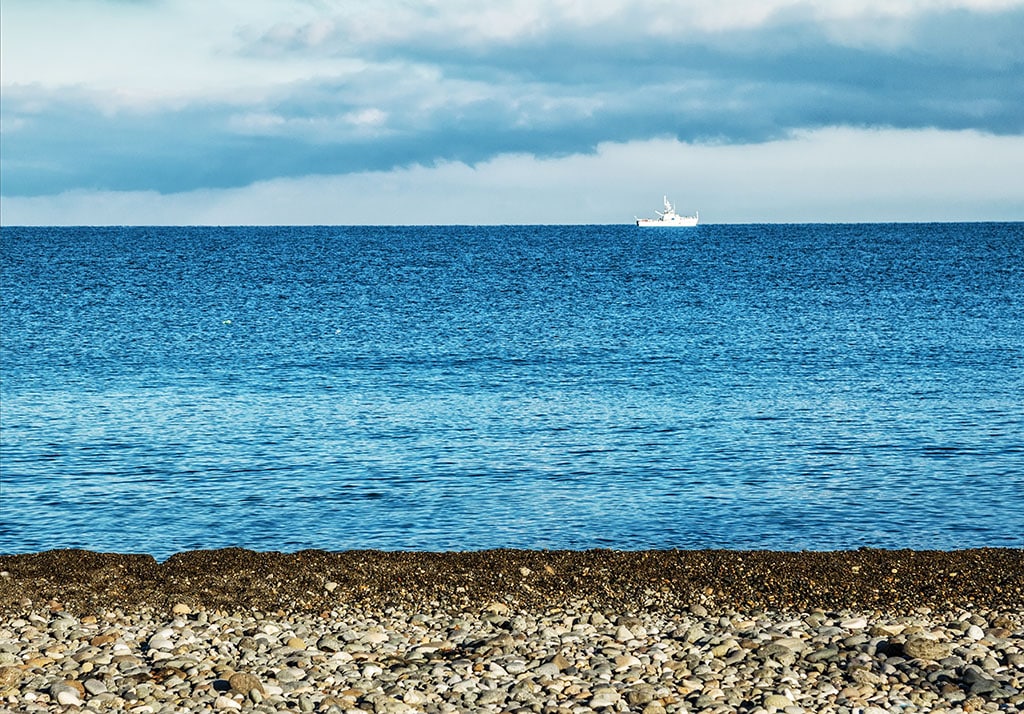
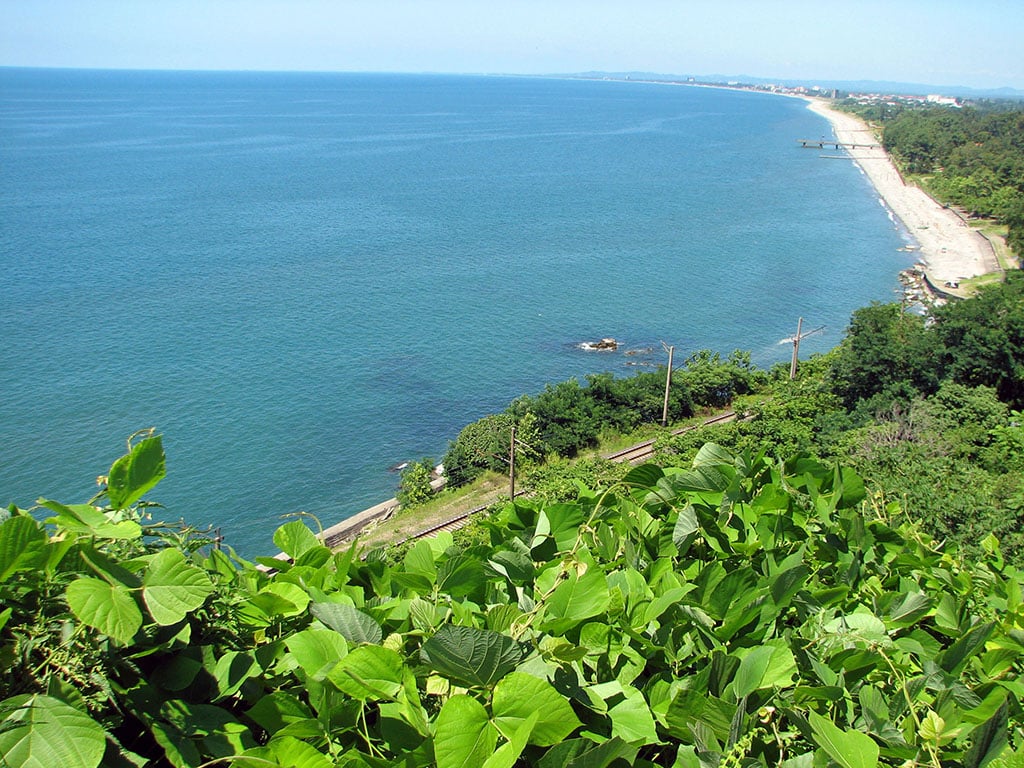
Kobuleti is a resort town, and residents’ whole lives revolve around the sea. Buildings and houses start 5–10 metres from the beach. Local boys spend their whole childhood in the water and say they grew up in the sea. In summer the town fills with tourists who come to bask in the southern sun. To say the town beach is huge is an understatement: it is more than 10 km long and 5 to 15 metres wide.
Kobuleti is the administrative centre of the district of the same name. The town has many hotels, a recently built modern clinic with the latest equipment, and plenty of parks, entertainment and cultural centres welcoming visitors.
Residents, whose main income comes from the 2–3 months of the holiday season, get their guesthouses, cafés and bars ready for summer. By late June the town is fully ready for tourists.
As tourism is the town’s main economic sector, Kobuleti trains its own hospitality staff. There is a multi-profile vocational school that trains hotel staff, guides, cooks, bartenders, electricians, welders and more to a high standard. Teachers have been invited from Europe, and students regularly take part in international vocational competitions. They do their practical training at tourist venues.
The Kobuleti municipality has three large, unique nature reserves and many historical monuments.
Sights of Kobuleti
Petra Fortress
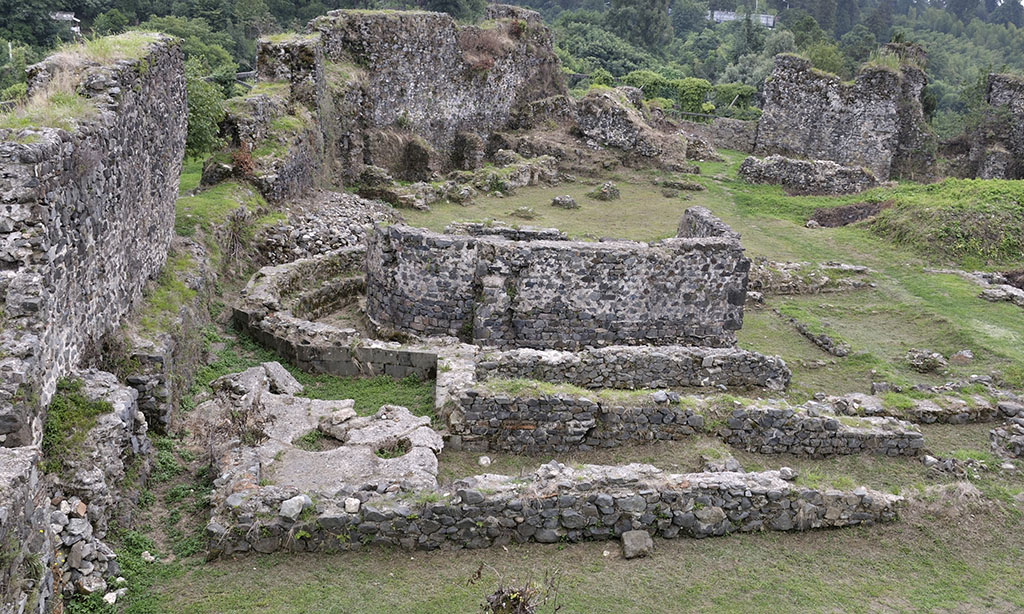
The ruins of the remarkably beautiful and unique Byzantine fortress of Petra stand on a hill in the village of Tsikhisdziri, which means “under the fortress”. Tourists see the ruins when driving from Kobuleti to Batumi.
Petra was considered an impregnable fortress city in the Kingdom of Egrisi. The place where it was built had great strategic, military and trade importance, which is why the Byzantine emperor Justinian decided to build it in 535.
A narrow trade route linking Georgia with Armenia and Byzantium ran past the fortress. Fierce battles against Turkish invaders also took place here.
Today the fortress is an archaeological complex in ruins, including a citadel, an outer town and residential buildings.
Among the ruins you can make out a storeroom that served as a cold store. The fortress had a well and a cistern for storing water.
A cross once stood at the entrance to the fortress; later the Turkish conquerors threw it down and smashed it. The foundation and ruins of a three-nave basilica, probably destroyed by the Turks, have survived.
You can also make out prayer rooms from the 10th–14th centuries, the ruins of a bathhouse and a wine store.
Archaeological excavations have been carried out at the fortress since 1987; before that, there was a lemon orchard here. Today Petra Fortress is a museum-reserve. More about Petra Fortress.
360° panorama of Petra Fortress:
The Ispani bogs (Kobuleti Nature Reserve)
Just a 15-minute walk from Pichvnari beach, visitors can see a completely different and unique natural area: the Ispani bogs. They are divided into two zones, Ispani-1 and Ispani-2.
It is an ecological reserve, as the bogs are the only untouched natural peatlands in the world covered with four species of living sphagnum (white moss). This moss is a plant that has survived from prehistoric times. Its presence shows the area is ecologically clean: the slightest pollution of the air, soil or water kills it.
The bog is filled with water only by rain and loses it only through evaporation. It covers 770 hectares, of which 331 hectares are a strict reserve and the rest is a buffer zone.
Many visitors think these are ordinary bogs, but that is not the case. The Ispani bogs look like a lake with clean drinking water, but an unusual one: the surface is covered with a 25 cm layer of white moss that never goes under water.
Practical humans have not got their hands on these natural riches, so a unique ecosystem has survived. Ecologists are trying to prevent drainage work, which has happened across almost the whole Colchis lowland.
During migration, 122 species of migratory birds stop at these bogs, and hunting them in the reserve is strictly forbidden. So the birds really do rest here, without fear, during their long flights.
Besides hunting, collecting plants for herbaria is also forbidden, and visitors should know this, or they may face a hefty fine. Order is kept by rangers, who also help visitors cross the bogs without harming even the moss underfoot.
The bogs also have plants that are unusual for the subtropics, which makes the reserve even more unique. Surprisingly, these bogs help fight mosquitoes that carry malaria and other dangerous diseases, as a carnivorous plant, the sundew, grows here and feeds on mosquitoes, flies and other insects.
Georgia joined the Ramsar Convention in 1996, and Ispani-2 received the status of a wetland of international importance.
Kintrishi Nature Reserve
Kintrishi Nature Reserve is only about twenty kilometres from Kobuleti, but once there, visitors find themselves in a completely different setting. The reserve is a unique natural landscape found only in this region. The mountain slopes are covered with jungles of relict forest, and the hiking trails sometimes lead to the Kintrishi River, which rushes down to the Black Sea.
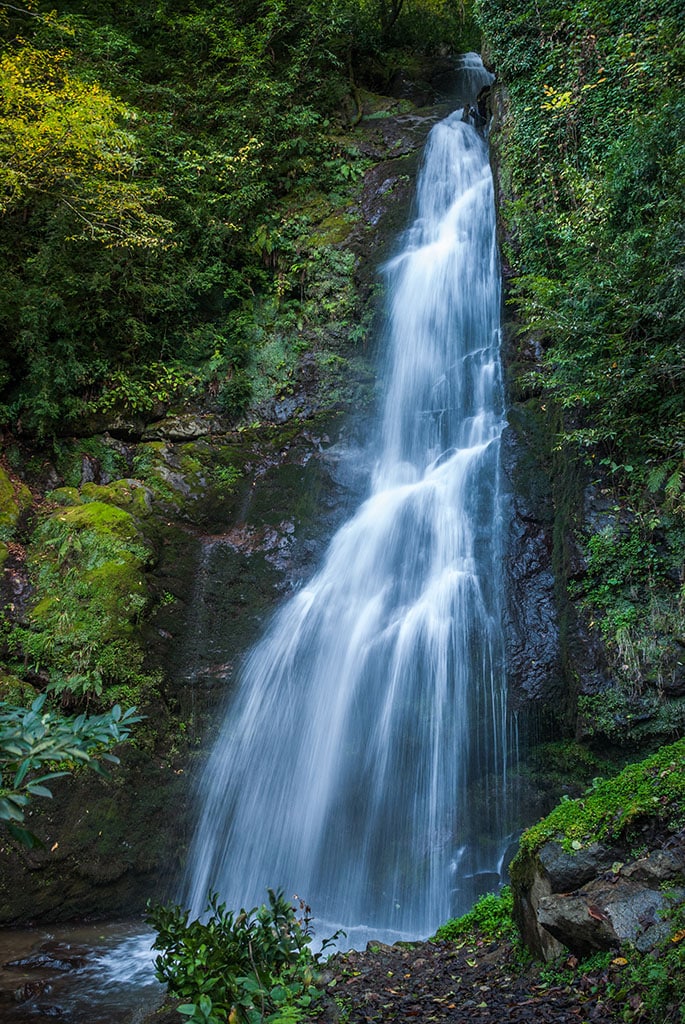
The river is the main artery of the reserve and rises on a mountain named after Nino, the missionary from Cappadocia who persuaded the Georgian King Mirian to adopt Christianity and was canonised by the Georgian Orthodox Church. On its way to the sea the river repeatedly plunges as waterfalls from sheer cliffs or flows down in cascades.
Over the Kintrishi River there are several arched bridges built in the Middle Ages, when Georgia was a strong and wealthy country. That period went down in Georgian history as the Golden Age, the reign of the much-loved Queen Tamar, and all the arched bridges built in the 10th–13th centuries bear her name. Most amazingly, the bridges are still strong enough to serve people, and cars even drive over one of them.
The reserve has the monastery and Church of St George, which has no historical value, as it was built fairly recently and opened in 2005. In the past there were hardly any churches in inner Adjara, as most of the population was Muslim. Now people have returned to the religion of their ancestors and started building churches. At first it was a monastery for monks, but since 2010 nuns have replaced them and it has become a convent.
On the monastery grounds there is an old wine store: the remains of large clay vessels for traditional Georgian wine have survived. The monastery is 600 metres from the waterfall and one of the arched bridges, and visitors can come and learn a lot.
Kintrishi Nature Reserve is a perfect place for a picnic.
Mtirala National Park
Mtirala Park lies between the Black Sea and the Adjara mountains, in the basins of the Chakvistskali and Khoralistskali rivers. The area receives 4,500 mm of rain a year. It is one of the wettest places in Europe, second only to the west coast of Scotland, though residents of the village of Chakvi doubt that anywhere else it rains as often. The name of the park and the mountain means “weeping”, and a haze of mist hangs over the mountain almost all year round.
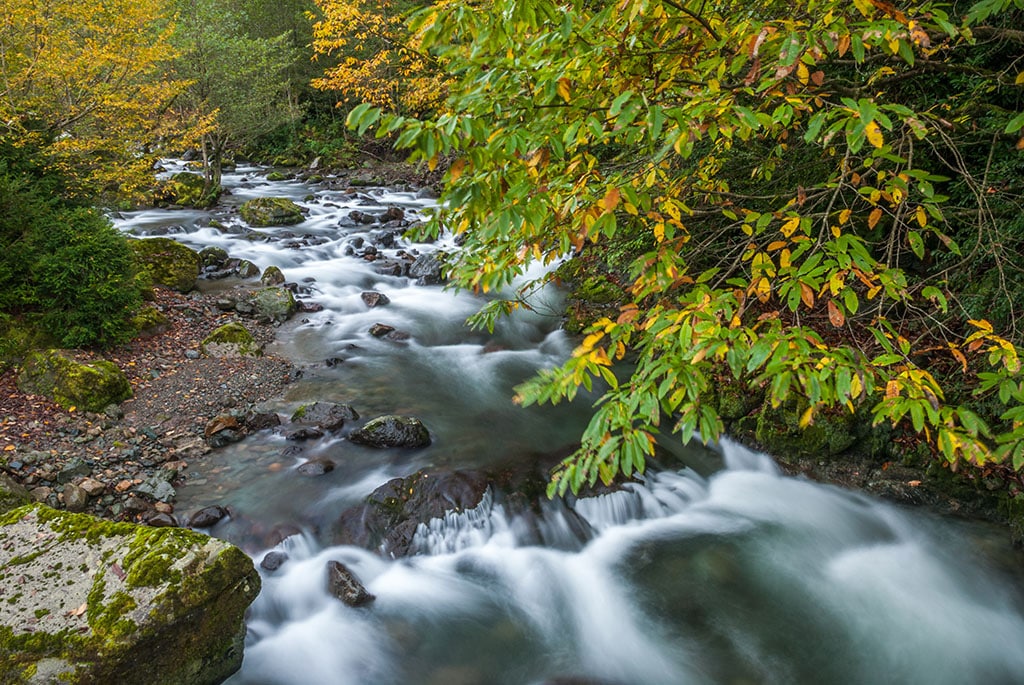
The park was created to preserve the unique Colchic forests, which have survived in their original state. The rangers working here try to protect not only the plants but the whole ecosystem, formed over thousands of years.
In the park, eco-tourists are accompanied by rangers who introduce them to the unique nature of the Weeping Mountain. There are two walking routes:
-
- A 3.5 km route that takes about 3 hours. It lets you see the beautiful and unique nature, a waterfall and a lake.
- A two-day, 9 km route up the mountain, with a place to rest and feel as if you are in a wild jungle.
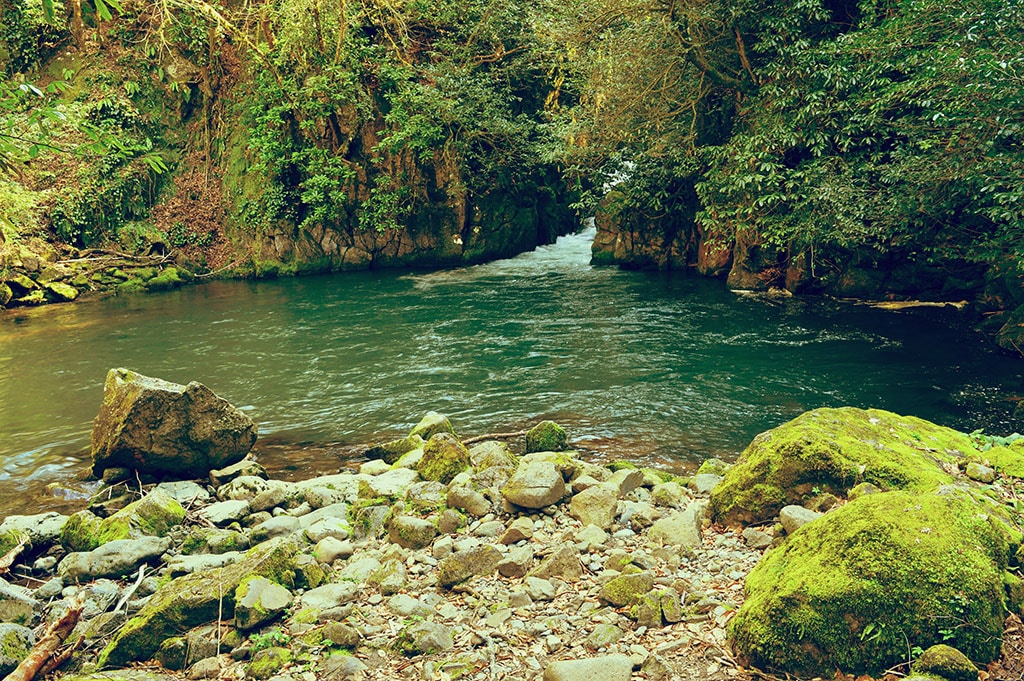
In Mtirala you can have a picnic, get away from the bustle of modern life, feel at one with nature and see unique endemic plants found nowhere else on Earth.
95 species of fauna are recorded in the park. Its pride is large mammals listed in the Red Book: the brown bear, the chamois and the Caucasian lynx.
The park covers almost 16,000 hectares and is divided into three zones:
- a strictly protected zone where all human activity is forbidden;
- a tourist zone where you can relax, have picnics, pitch tents and light fires;
- a third zone where farmers live and are allowed to carry on traditional work. Twelve families farm in the protected area.
The third zone also has two private guesthouses and a visitor centre with an exhibition hall, where you can learn about the traditional way of life and cuisine.
Entrance and walks in the park are free.
Famous people from Kobuleti
Kobuleti is the hometown of many famous people.
The descendants of Mikhail Zedgenidze, a hero of the Russo-Japanese War (1904–1905) and military engineer at Port Arthur who took an active part in its defence, live here in the house where he was born.
Kobuleti is the hometown of the legendary singer Guram Tamazashvili, founder of the “Georgian Voices” ensemble, who did a great deal to popularise and preserve unique Georgian polyphonic singing. His brother and sister still live in the town.
Many older football fans remember the star Dinamo Tbilisi team that beat Germany’s Carl Zeiss Jena in the 1981 European Cup Winners’ Cup final. Alongside Aleksandre Chivadze, David Kipiani, Vitaly Daraselia, Vladimir Gutsaev and others, Kobuleti-born Revaz Chelebadze played in that team.
In honour of the legendary footballer, the town named its renovated 6,000-seat stadium “Chele Arena”. Chelebadze himself, a former USSR national team player, is the coach and owner of the town’s club Shukura, which plays in Georgia’s top division and where he started his career.
Kobuleti is also the hometown of Irakli Turmanidze, Georgian weightlifting champion, European champion and bronze medallist at the 2016 Rio de Janeiro Olympics.
Kobuleti is also proud of its famous native Nino Katamadze, the outstanding jazz singer admired around the world, who has also left her mark on rock music. She often visits her hometown, and if you are lucky you may catch one of her concerts.
How to get to Kobuleti from Tbilisi, Kutaisi and Batumi
Kobuleti is on the Tbilisi–Batumi highway and has a railway station, so it is easy to get here from any city.
From Tbilisi the Metro Georgia buses are very convenient: comfortable, with screens on the seat backs and air conditioning.
The next convenient option is a minibus: less comfortable, but much faster.
And finally, the train. Any train on the Tbilisi–Batumi route stops in Kobuleti. Ticket prices depend on the class and the train. If you fancy a ride on a double-decker train, there is one on the Tbilisi–Batumi route.
Georgian trains have Wi-Fi, so when you get tired of the scenery, you can spend time online.
From Kutaisi you can take any minibus heading to Batumi from Kutaisi bus station, or catch a transit minibus passing through the city.
For reference: Kutaisi bus station is on the Tbilisi–Batumi highway.
From Kutaisi airport you can catch a minibus passing the airport, which is also close to the main highway to Batumi.
From Batumi minibuses to Kobuleti leave almost every half hour from various stops. You can also take a passing train, or a taxi: the road is short, about 25 km, and it is easy to order a car through an app.
Kobuleti FAQ
How far is Kobuleti from Batumi?
About 25 km. Minibuses run from Batumi roughly every half hour, there are trains, and a taxi via an app takes about 30 minutes.
What is there to see in Kobuleti?
In the town itself, the beach and the local history museum. Nearby are Petra Fortress in Tsikhisdziri, the Ispani bogs, Kintrishi Nature Reserve with Queen Tamar’s arched bridges and Mtirala National Park.
When is the best time for a beach holiday in Kobuleti?
From late June to September, when cafés, guesthouses and beach facilities are open.
Where can I go with children in Kobuleti?
The beach and the Tsitsinatela amusement park near the town. It is best to go there by taxi and agree with the driver to pick you up.
Tips for visitors
Kobuleti is called the “golden mean” for a reason: it lies between Batumi and Ureki. The sea in Kobuleti is the cleanest; families with children are more comfortable in Ureki and young people in Batumi, but a holiday in Kobuleti is cheaper than in Batumi or Ureki.
Kobuleti has many cafés and small restaurants serving national dishes. The food is tasty but spicy, as pepper and spices are used generously, so if you are on a diet or ordering for children, warn the waiters, or choose a guesthouse with a kitchen (there are plenty in Kobuleti) and cook yourself.
Kobuleti is a well-known, beautiful beach resort that draws tens or even hundreds of thousands of sun-seekers. Crime in Georgia is low, but it is better to be careful: crowds of tourists attract pickpockets, as anywhere in the world.
Not far from Kobuleti is the Tsitsinatela amusement park, a good place to go with children. It is best to go by taxi and agree with the driver to pick you up or wait. The park is open from the evening until late at night and has a first-aid post.
Around town it is better to get about by rented bicycle than by minibus. Kobuleti has one main street and a couple of parallel ones, so it is almost impossible to get lost, but do remember your house number and street name. If Aghmashenebeli Street is hard to remember, you can say Lenin Street (it bore that name for many years), and older locals will understand.
Read also: Adjara: top 30 attractions near Batumi, Borjomi.

Hello!
I am Victor, the founder of this site and its main, but not the only author.
Traveler and photographer. Visited more than 60 countries.
Born and raised in Batumi. I love to travel in Georgia.
More about me here.