


Ananuri fortress is unique and captivating. Its eventful history and silent grandeur, together with the incredible beauty of the surrounding nature, draw visitors from all over the world. Locals love coming here with family or friends again and again. People come to Ananuri to feel its silence once more, to enjoy the turquoise of the Zhinvali Reservoir, on whose shore this medieval monument stands, to think about eternal things and to take a break from everyday worries.
Ananuri is worth a visit if:
– you love history, legends, art and old architecture;
– you want to immerse yourself in an atmosphere very different from the pace of a big city;
– you are travelling with children. This is the perfect place to tell stories about brave knights and beautiful princesses while broadening your kids’ horizons.
So what makes this fascinating castle famous?
Ananuri fortress: the trip in brief
Ananuri is a medieval fortress on the Georgian Military Road, in the Dusheti district, where the Aragvi and Vedzatkhevi rivers meet, on the shore of the Zhinvali Reservoir. It is on the UNESCO World Heritage Tentative List. In short, here is what you need to know:
- How far: about 70 km from Tbilisi, roughly an hour by car.
- Entrance: free.
- How much time you need: 40 minutes to an hour for the fortress itself; if you want to go down to the water, allow a couple of hours.
- What to see: the 17th-century Church of the Assumption with its carved façades, the Sheupovari tower with the best view of the reservoir, and the pyramid tower, the oldest building in the fortress.
- What to combine it with: Ananuri is on the way to Pasanauri, Gudauri and Stepantsminda (Kazbegi), so people usually stop here on the way to the mountains.
What to wear
The churches in the fortress are active: women need a headscarf and a skirt, and shoulders should be covered. Steep steps lead up the Sheupovari tower, so wear comfortable shoes.
Is it worth going?
Yes. Even if you are heading to Kazbegi, a stop at Ananuri takes an hour and leaves a lasting impression: the old towers against the turquoise water are one of the most beautiful sights on the whole Georgian Military Road.
Sights of Ananuri
Architecture
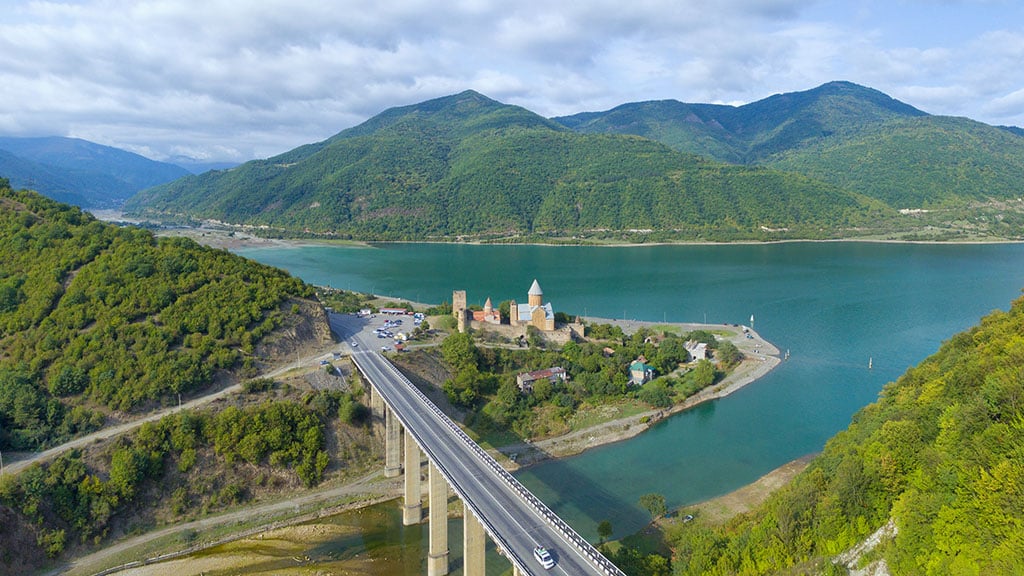
Ananuri is an old defensive complex about 70 km from Tbilisi, the capital of Georgia, on the left bank of the Aragvi River, along the famous Georgian Military Road.
There is something alluring about these grim buildings. People come to feel the atmosphere of the Middle Ages, with all its dark and dramatic events. Traces of past battles are everywhere. You do not have to be an architecture expert to appreciate Georgia’s towers, especially at Ananuri.
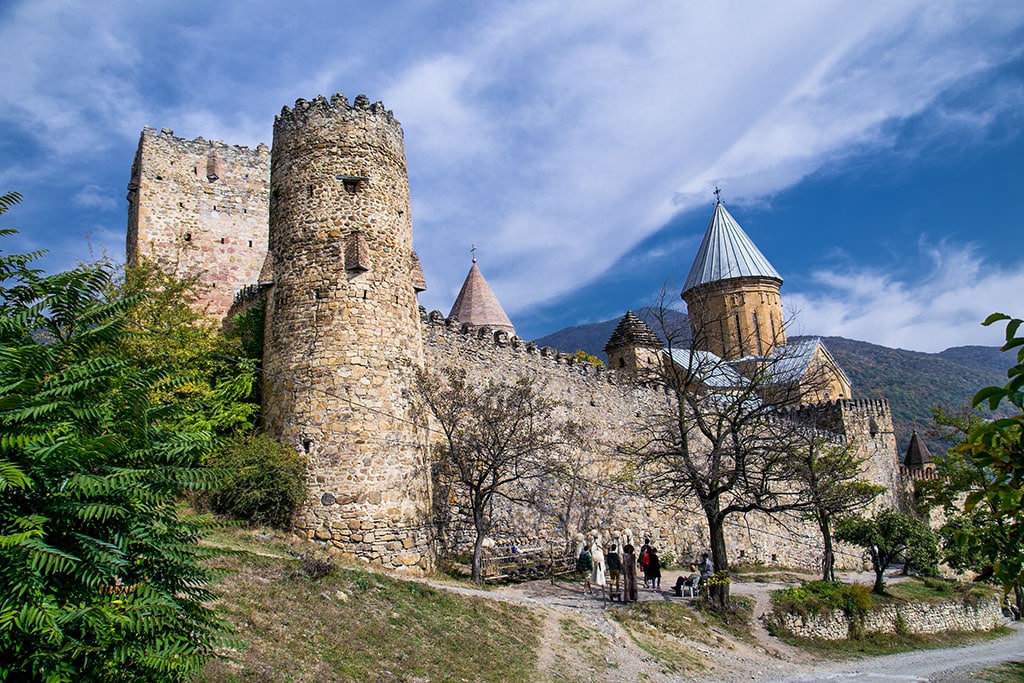
Originally the walls of the fortress were 5–6 metres high, but that was not enough for effective defence, and later they were raised by another 2–3 metres. A lower fortress, three times larger than the upper one, was added on the east and north sides. Its walls are now almost completely destroyed, and many buildings were put up in its former courtyard in the 19th and 20th centuries, so its original appearance could not be restored.
The surviving circular wall of the upper fortress has five different towers with loopholes and machicolations (openings for shooting, also used to pour hot tar on the enemy). Medieval Ananuri meant business!
Entrance tower
The entrance is also protected by machicolations. The gate is on the ground floor of the entrance tower, with three more floors with wooden ceilings above it. The second floor was probably living quarters, and the two upper floors were used for defence, with a terrace at the very top. The side walls of the square tower have pointed niches.
North tower
The northern walls include a low three-storey tower that projects out from the wall in a semicircle. The northern walls are thicker at the bottom and thinner at the top, with beautiful battlements along the upper edge. A ledge on the inside was used by the defenders to move along the wall. Today fearless tourists like to climb onto it for an incredible view of the Zhinvali Reservoir.
The “Steadfast” tower
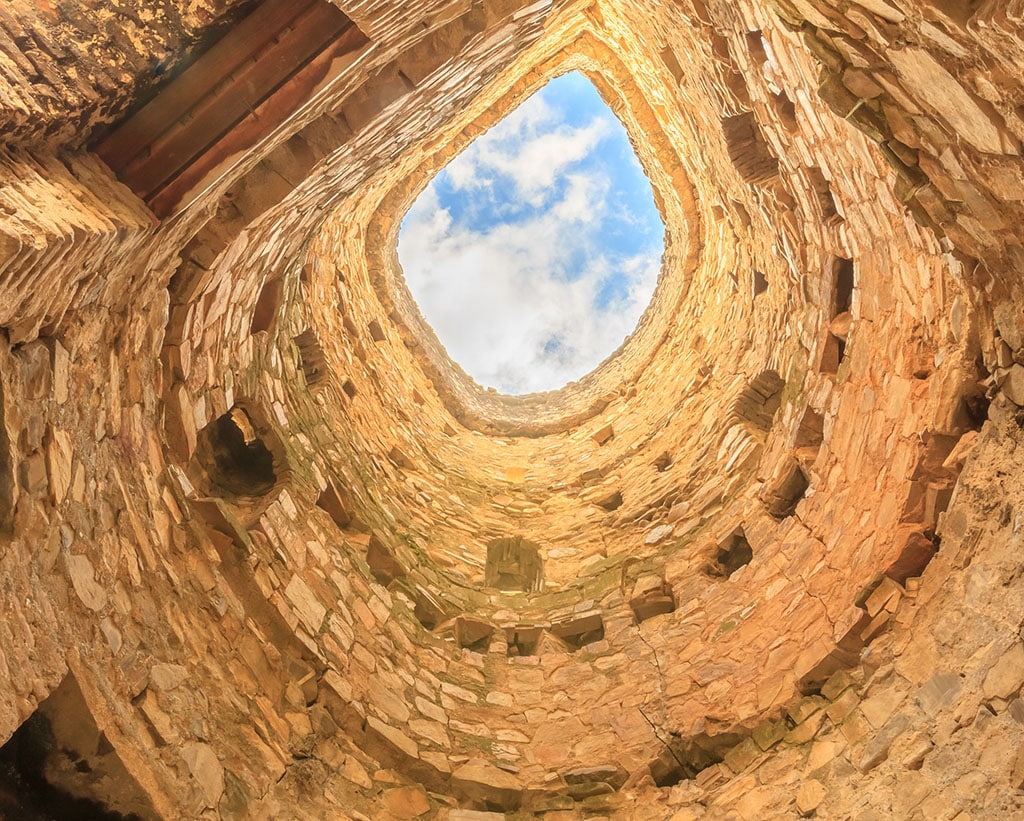
Sheupovari is the largest, square tower of Ananuri. Its walls are about one and a half to two metres thick and narrow towards the top. It has seven floors, six of which had fireplaces besides loopholes and niches for observation and shooting. The wooden floors between levels have survived a little better than in the other towers, and only in Sheupovari can you climb the steps all the way to the top and take great photos.
Pyramid tower
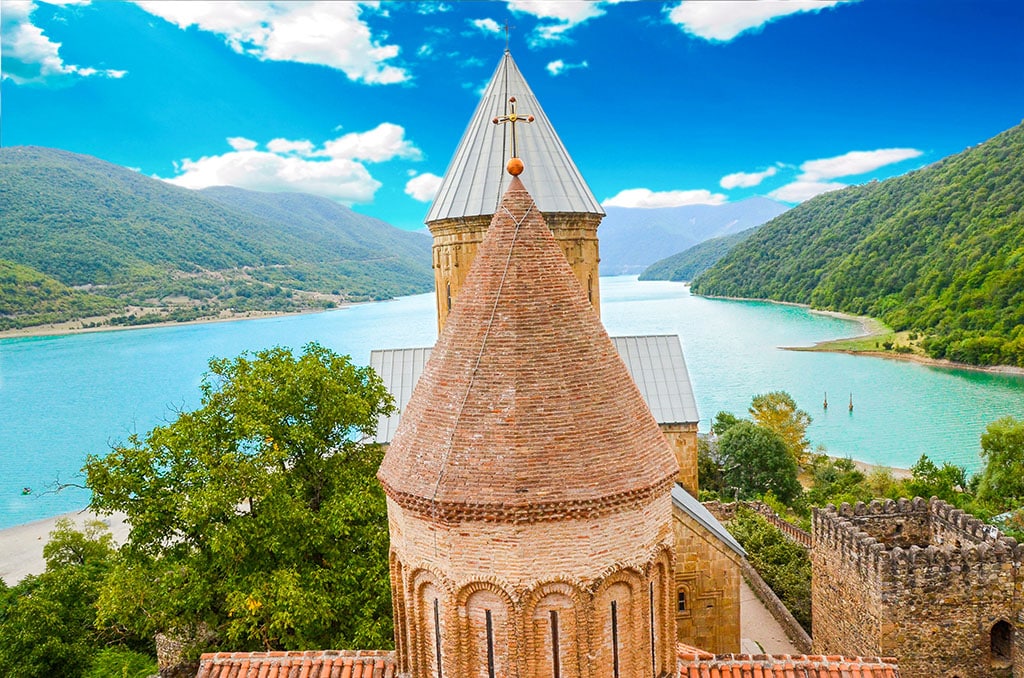
Among all the buildings, an interesting pyramid-shaped tower with a stepped roof stands out. It is considered the very first structure built at Ananuri. Towers of this type are also called Khevsurian.
The Church of the Assumption and other churches of Ananuri
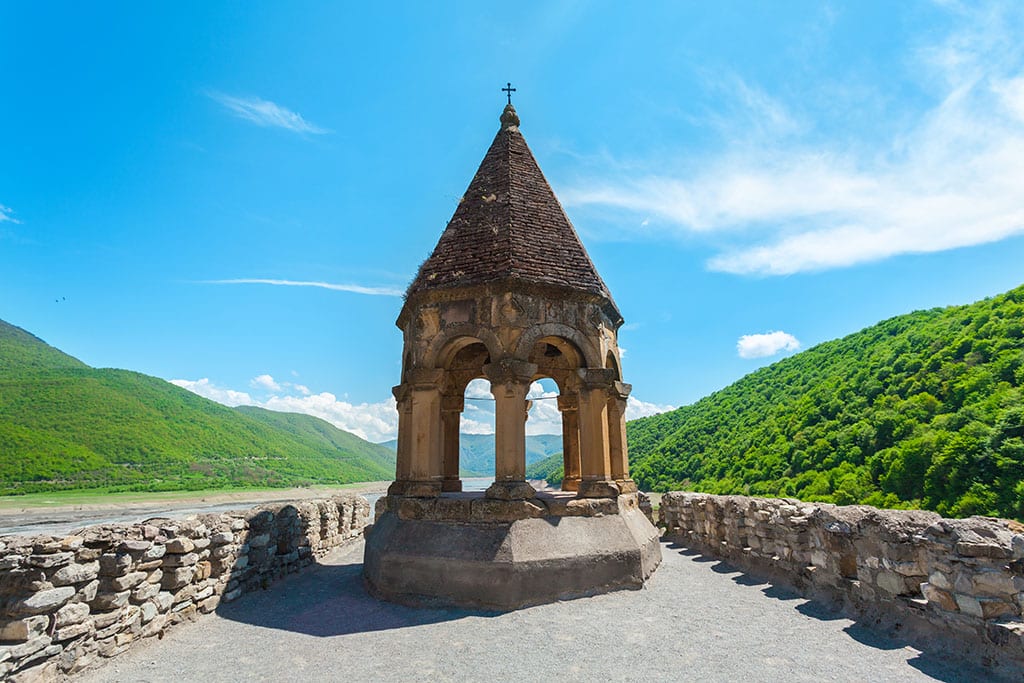
The Mkurnali church was built in the lower, ruined part of Ananuri. Its bell tower is decorated with beautiful arches, and its columns have eight sides. It looks stunning against the turquoise waters of Zhinvali.
The Church of the Virgin Mary has a tombstone with a carved text saying that in 1674 it was placed by Anna Abashidze in memory of her husband, the mdivanbeg Edisher, son of eristavi Giorgi and brother of eristavi Otar. Curiously, Anna complains in the text that God sent her five daughters but not a single son.
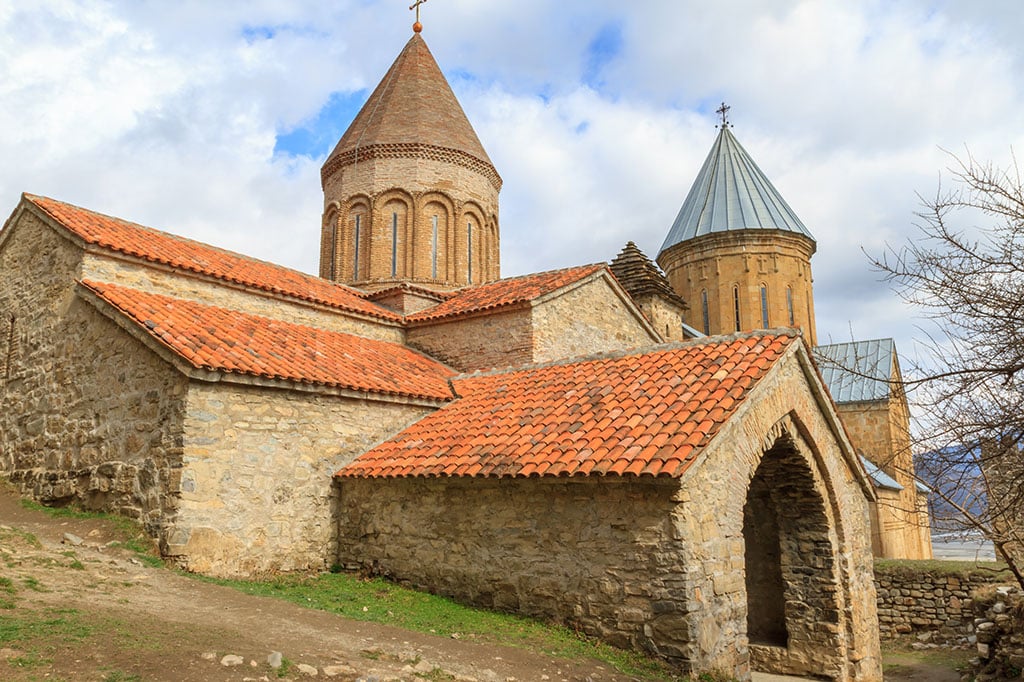
The Church of the Assumption is the largest church in the complex. It was built by the mdivanbeg Bardzim, as the text on one of its outer walls says.
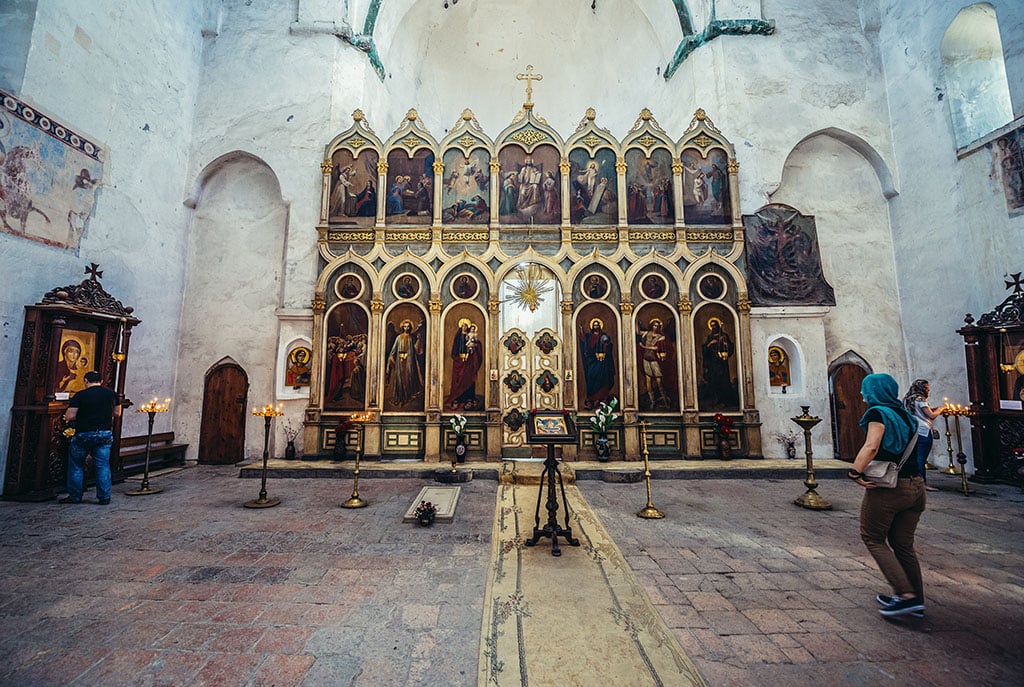
Its façades are decorated with rich carvings of crosses, people, cherubs, animals and grapevines with birds pecking at the berries. Beautiful frescoes are partly preserved inside. If you climb to the top of Sheupovari tower, you can take lovely photos of the Church of the Assumption from above.
History of Ananuri fortress
The complex was originally built to defend the road along which its buildings are so picturesquely set. This is the old road, which is now partly flooded, so you can only drive along it up to a certain point. The modern road was built much later, higher than the old one. The fortress covered the retreat into the mountains, sheltering not only people who lived nearby but also residents of other regions of Georgia fleeing the enemy.
How the people of Ananuri lived
It is hard to imagine, but life was once bustling here: from the 13th century the area was ruled by the dynasty of the Aragvi eristavis (a Georgian feudal title, third in rank after king and prince).
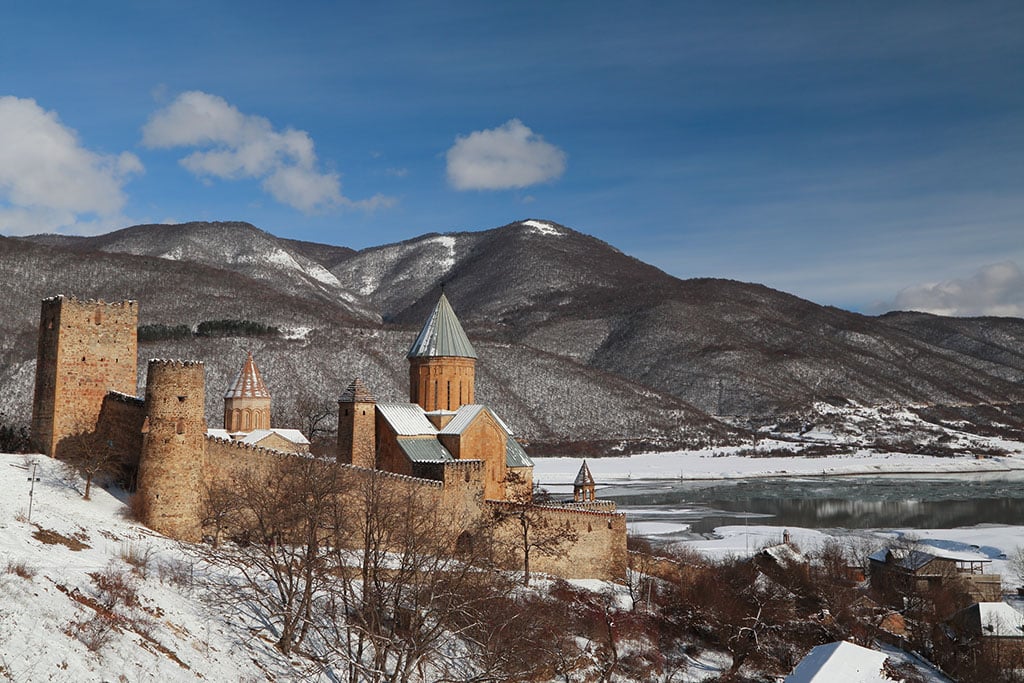
Feuds broke out between the eristavis again and again, the fortress survived many battles and its walls saw a lot of blood. Perhaps that is why visitors say that at Ananuri you feel the transience of life especially strongly.
Today only the citadel remains of the fortress’s former grandeur. It was the last stronghold, meant to hold the garrison and its supplies if all the main fortifications fell. Amazingly, despite all the battles and a fire, the oldest structure has survived: the very first tower with the pyramid roof.
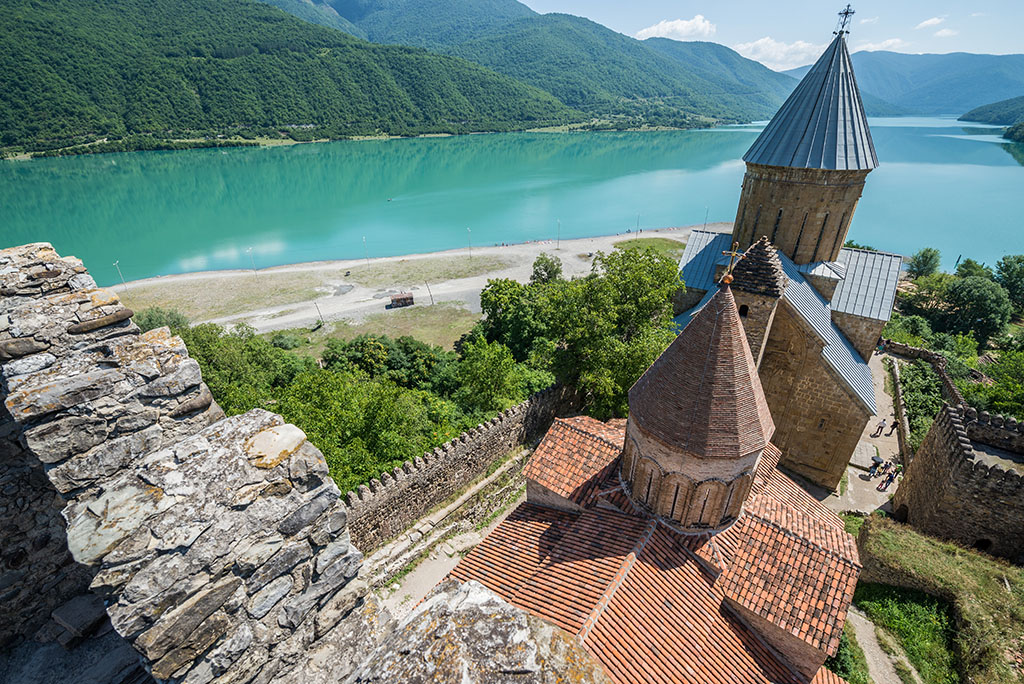
Not all visitors know that below the castle, on the way to the reservoir, there is an abandoned church with a grass-covered roof, and you can see the ruins of the fortress walls.
The fortress was inhabited until the early 19th century. After Georgia joined the Russian Empire, a Russian garrison was stationed here to guard the road linking Georgia and Russia and to keep order.
The castle’s turbulent past
– after Utrut, son of the Aragvi eristavi, was burned alive in Sheupovari tower, the entrance to the tower was walled up for two hundred years;
– a captured heir to the Iranian throne was once held prisoner at Ananuri and later handed over to the shah;
– in 1812 the castle was attacked by highlanders who rose up against the Russian garrison stationed there; reinforcements from Tbilisi left the proud mountain people no chance;
– the fortress had a water supply with ceramic pipes and two reservoirs inside its walls;
– in 1829 Ananuri was visited by Alexander Pushkin on his journey along the Georgian Military Road.
Zhinvali Reservoir
The Zhinvali Reservoir is 40 km from the capital and supplies it with water. It is the largest artificial lake in Georgia, 14 km long and 75 metres deep, covering 12 km². Villages along the Aragvi River were flooded to create it.
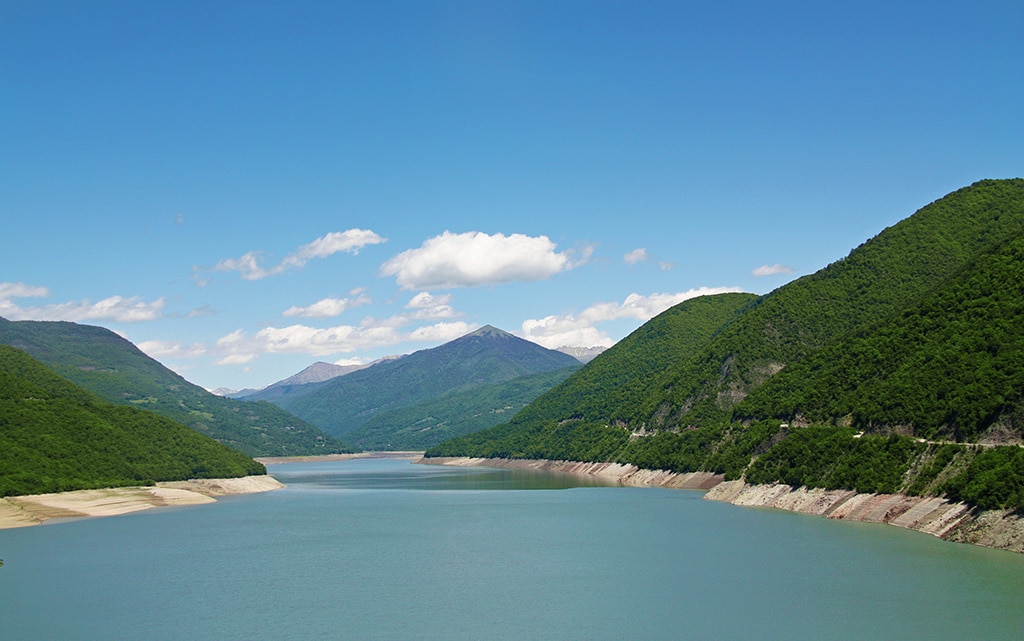
Nearby are the Zhinvali hydroelectric power station and the village of the same name.
On the way from Tbilisi to Zhinvali there are several viewpoints where people stop to take beautiful photos of the dark-green wooded slopes and the unusually bright turquoise water.
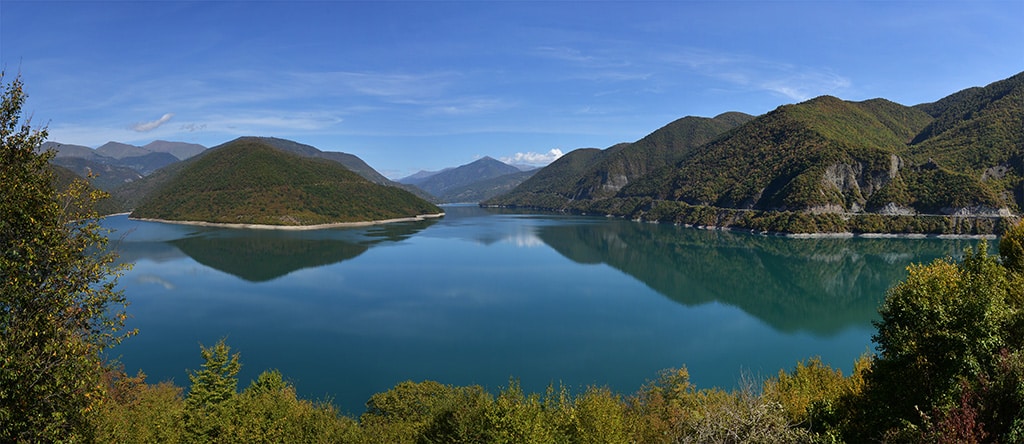
In Georgia, historical monuments are everywhere, and Zhinvali is no exception. There was once an ancient town where the reservoir is now, and remains of its buildings can still be found on the shores.
Ananuri fortress FAQ
How much does it cost to visit Ananuri?
Entrance is free.
How do I get to Ananuri from Tbilisi?
By minibus from the bus station at Didube metro towards Kazbegi, Gudauri or Pasanauri: ask the driver to drop you off at the fortress. A car with a driver is more convenient, as you can also stop in Gudauri.
How far is Ananuri from Tbilisi?
About 70 km, roughly an hour by car.
Where is the best view of the Zhinvali Reservoir?
From Sheupovari tower in the fortress and from the viewpoints along the road from Tbilisi.
Ananuri on the map of Georgia
How to get to Ananuri from Tbilisi
If you drive to Georgia from Russia, you will not miss Ananuri: it is the first castle and one of the first cultural monuments you will see in Georgia. But you may be tired and decide to come back later for a proper visit. In that case, or if you arrive in Georgia by plane, you can come from Tbilisi or Batumi.
From the capital you can choose the option that suits you best:
– take a minibus to Stepantsminda (Kazbegi), Pasanauri or Gudauri from the bus station at Didube metro. Ask the driver to drop you off at Ananuri; the ride takes about an hour.
– rent a car. If you have a licence, it is easy to do in Georgia; many companies offer this service. It is best to book in advance online with trusted companies.
– hire a private driver in Tbilisi, or use recommendations from friends who have already been to Georgia. This is the most convenient option: the driver will wait while you look around, and you can stop in Gudauri on the way.
– take a taxi. In Tbilisi it is convenient to order one through an app, but for Ananuri agree with the driver straight away that he will wait and take you back: it is not always easy to find a taxi back at the fortress. You can also return on a passing minibus to Tbilisi.
– join a tour, for example a group tour to Ananuri, Gudauri and Kazbegi.
To get to Ananuri from Batumi, you first have to get to Tbilisi.
If you are travelling by rental car, you can turn onto the Georgian Military Road at the fork before Mtskheta and drive straight to Ananuri. Even if you are coming from Batumi by bus or minibus, you can get off there, wait for the right minibus, and later return to Tbilisi by minibus.
But we still recommend resting first, especially since there are hundreds of interesting places around Tbilisi and Mtskheta. It is best to set aside a separate day or half a day for Ananuri, or combine it with a trip to Gergeti and Stepantsminda.
Ananuri fortress opening hours
You can visit Ananuri every day, from 10:00 to 18:00. Entrance is free.
Restaurants near Ananuri
About 100 metres before the fortress, by the road, is the Ananuri restaurant. Locals recommend it to visitors and praise it highly. The restaurant on Facebook and Google Maps.
There is also the Monadire restaurant with a large garden before Ananuri. What makes it special is that you can eat not only at a table but also, for example, sitting under a tree or lying on the grass.
A little further past the castle you will find other places to eat and share your impressions; the Kakhaberi restaurant, for example, gets good reviews.
Read also: Georgian Military Road, Gergeti and Stepantsminda, Top 15 attractions in Georgia.

Hello!
I am Victor, the founder of this site and its main, but not the only author.
Traveler and photographer. Visited more than 60 countries.
Born and raised in Batumi. I love to travel in Georgia.
More about me here.